When Great Tech Isn’t Enough
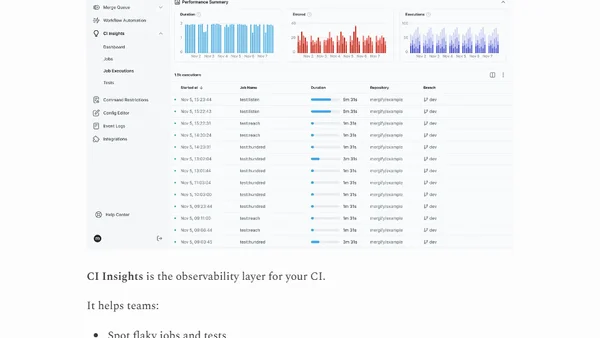
A tech team's story of pivoting from a CI cost tool to a CI reliability product, only to realize they built great tech but not a viable product.
Julien Danjou est un vétéran de l'open source avec 25 ans d'expérience, CEO et co-fondateur de Mergify, et créateur du gestionnaire de fenêtres awesome. Découvrez les insights du plus jeune développeur Debian en 2002, leader du projet de télémétrie OpenStack et créateur de la base de données de séries temporelles Gnocchi. Explorez l'expertise issue des innovations cloud computing chez Red Hat, du développement du profileur Python chez Datadog et de la maîtrise des mécanismes internes de CPython. Apprenez de l'auteur des livres "Serious Python" et "Scaling Python", animateur du podcast français CI/CD "Nom d'un Pipeline!" et fondateur du Toulouse SaaS Club. Suivez pour des insights sur les plateformes SaaS, l'expertise en développement Python, les meilleures pratiques CI/CD, l'optimisation de l'expérience développeur, les contributions GNU Emacs et la programmation Lisp. Accédez aux connaissances sur l'automatisation de fusion de code, la collaboration d'équipes d'ingénierie logicielle et l'architecture cloud computing.
239 articles from this blog
A tech team's story of pivoting from a CI cost tool to a CI reliability product, only to realize they built great tech but not a viable product.
An article arguing that engineers should not use complexity as an excuse for poor design, emphasizing the importance of creating simple user experiences.
A startup's journey building a CI/CD cost optimization tool, discovering engineers didn't prioritize cost savings and struggled to find product-market fit.
Explains the pitfalls of poorly typed Python wrapper functions and how they can bypass static type checking, leading to runtime errors.
A startup's story of building and then killing a CI/CD cost optimization tool after realizing they were solving the wrong problem.
A SaaS founder shares lessons on evolving pricing models, focusing on fairness and value, from per-organization to per-active-user billing.
A tech company details their negative experience with Heroku's changing pricing and contract terms, leading them to leave the platform.
A remote work veteran reflects on the trade-offs between remote and in-person collaboration, highlighting benefits and communication challenges.
The founder of Mergify reflects on 2024, discussing the company's shift from tech-driven to product-focused, market challenges, and new product development.
Explores the future of social media where AI-generated content becomes indistinguishable from human creators, questioning platform authenticity.
A tech founder shares how Mergify built a project management approach based on simplicity, ownership, and autonomy, moving beyond rigid Agile dogma.
Mergify explains why it's sticking with seat-based pricing over the trending work-based model for its CI/CD automation SaaS, analyzing the fit for different products.
Mergify founders share lessons on avoiding common tech startup pitfalls by focusing on customer needs over just building features.
The article explains why Mergify, a developer tool, doesn't support GitLab, analyzing cultural biases in the French tech market and GitHub's market dominance.
A developer's critique of Dependabot's flaws under GitHub, including silent failures and slow updates, leading them to stop using it.
A tech professional explains the pitfalls of employee stock options, urging clarity on their value and highlighting psychological investment challenges.
Explains the concept of a product engineer, contrasting them with traditional software engineers by emphasizing user-centric design and business value.
Discusses the importance of testing API behavior beyond just the data model, using real-world examples like GitHub API issues.
Analyzes GitHub's evolution, its enterprise focus post-Microsoft acquisition, and its future relevance in the developer ecosystem.
A SaaS founder discusses strategies for small tech companies to compete when large corporations enter their market, using personal experience and the 80/20 rule.