Making XML human-readable without XSLT
Explores alternatives to XSLT for making XML files human-readable, as browser support for XSLT is being removed.
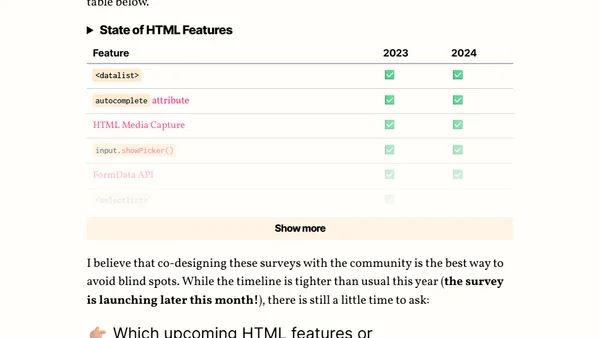
The State of HTML 2025 survey is now open, allowing web developers to influence browser vendors and web standards.
The author announces the State of HTML 2025 survey, explaining its history and how past results have directly influenced web standards.
Schedule of public tech talks and workshops on frontend development, JavaScript, and web standards for the first half of 2025.
A defense of Web Components, explaining their differences from JavaScript frameworks and why their long-term, standards-based approach is valuable.
A developer shares their new role at Font Awesome, focusing on Web Awesome and improving web UI development with web components and CSS.
The CSS WG has approved adding an inline if() function to CSS, a new feature for conditional logic within stylesheets.
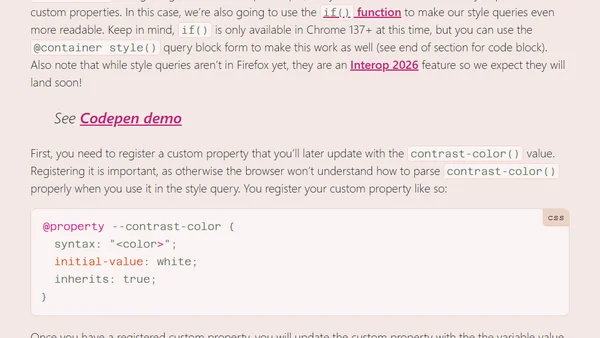
Exploring CSS Relative Colors to generate accessible text colors, comparing it to the upcoming contrast-color() function and discussing tradeoffs.
A developer reflects on how naming conventions and web standards create layers of abstraction that make modern web development possible.
The State of HTML 2023 survey is now open, gathering developer feedback to influence browser roadmaps and web standards.
Announcing the new State of HTML survey, seeking community input to design the inaugural survey on HTML features and developer practices.
Lea Verou's re-election statement for the W3C Technical Architecture Group, focusing on web standards and developer needs.
Announcing Color.js, a JavaScript library for advanced color manipulation, supporting CSS Color 4/5 and various color spaces.
Lea Verou's candidacy statement for the W3C TAG election, outlining her goals to improve web standards and platform technologies.
A guide to using the HTML <small> element for legal disclaimers and fine print, not for presentation.
Author explains their decision to leave the W3C to focus on personal projects, open source work, writing a book, and standards development.
Discusses the shift away from CSS vendor prefixes as features become stable, and the need to treat experimental features carefully.
The CSS border-corner-shape property is at risk of being removed from the spec. The author calls for developers to provide use cases to help save it.
A guide to using MathML for web equations with a CSS fallback for browsers lacking native support, based on a real-world use case.
The author expresses excitement for Web Platform Docs, a collaborative project by browser vendors to create unified web development documentation.