Training an LLM-RecSys Hybrid for Steerable Recs with Semantic IDs
Explores training a hybrid LLM-recommender system using Semantic IDs for steerable, explainable recommendations.
Analyzes push notifications as a recommender system, discussing intent, personalization, timeliness, and user engagement challenges.
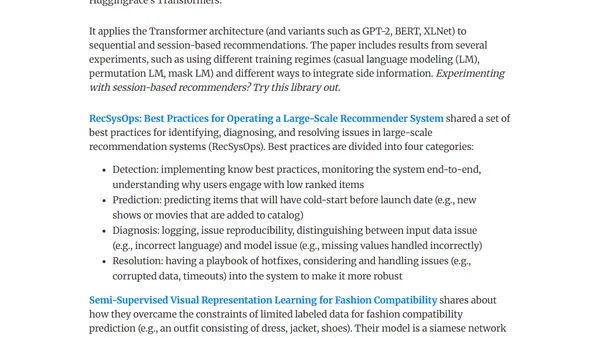
A recap of the RecSys 2022 conference, highlighting key trends, favorite papers, and lessons learned in recommendation systems.
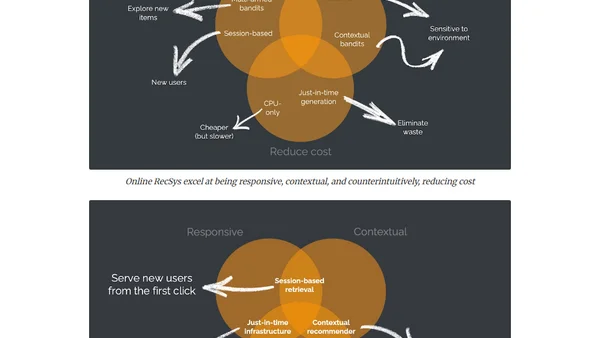
A keynote exploring the trade-offs between batch and online recommender systems, with real-world examples from Amazon Books.
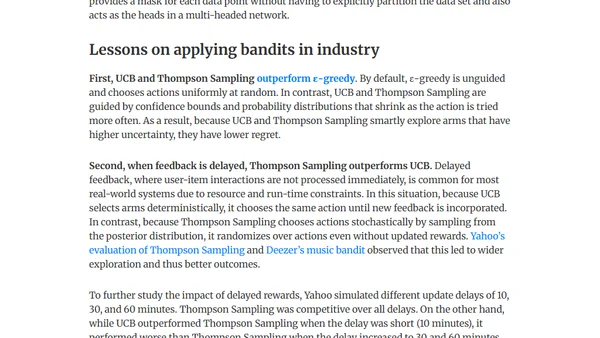
Explores bandit algorithms like ε-greedy, UCB, and Thompson Sampling to improve recommender systems by balancing exploration and exploitation.
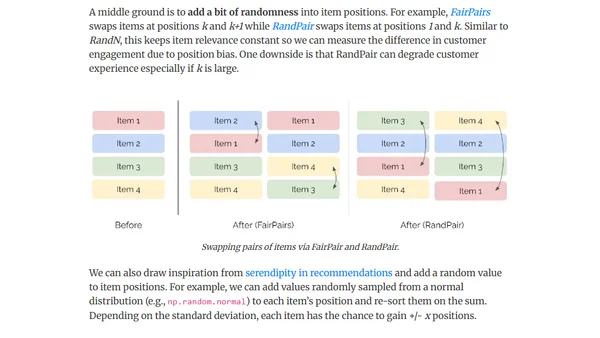
Explains position bias in recommendation systems and methods to measure and reduce its impact on user engagement and model fairness.
A summary of key papers and talks from the RecSys 2021 conference, focusing on collaborative filtering, model comparisons, and deployment strategies.
Key takeaways from RecSys 2020 conference, focusing on ethics, bias, sequence models, and notable papers in recommender systems.
Explores the importance of serendipity over just accuracy in recommendation systems, discussing metrics, user engagement, and business benefits.
A summary of a meetup talk on advanced recommender systems, exploring techniques beyond baselines using graph and NLP methods.
Explores improving recommender systems using graph-based methods and NLP techniques like word2vec and DeepWalk in PyTorch.
A guide to building a recommender system using PyTorch on a laptop, covering data acquisition, parsing, and multiple modeling techniques.
Explores handling Out-of-Vocabulary (OOV) values in machine learning, using deep learning for dynamic data in recommender systems as an example.
Explains how Taboola built a unified neural network model to predict CTR and estimate prediction uncertainty for recommender systems.
Explores how uncertainty modeling in recommender systems helps balance exploring new items versus exploiting known high-performing ones.