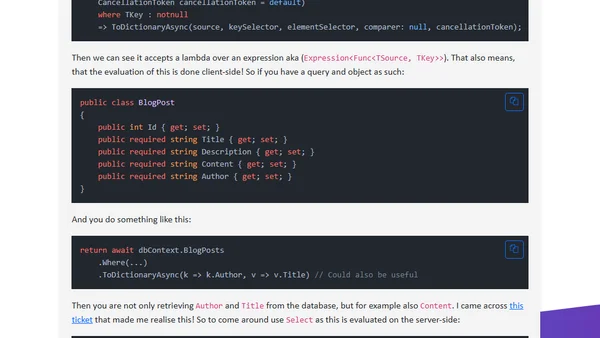
ToDictionaryAsync retrieves the whole object from the database in Entity Framework
Explains how ToDictionaryAsync in Entity Framework Core retrieves entire database objects, impacting performance, and provides a solution using Select.
Demonstrates a 6x speedup for analytics queries using EDB Postgres Distributed's new analytics engine compared to the standard Postgres engine.
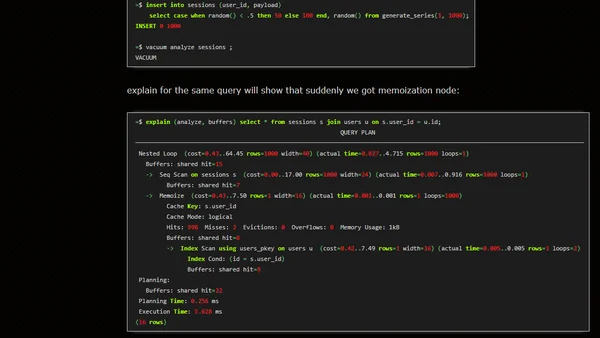
Explains a new PostgreSQL 19 feature that displays Memoize planner estimates in EXPLAIN output to help debug query plan choices.
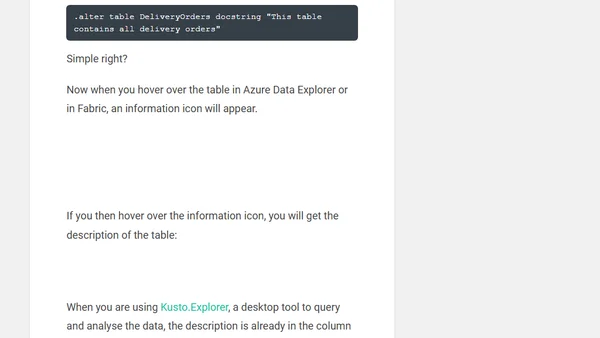
A guide on documenting and organizing Kusto Query Language (KQL) code using comments, docstrings, and folders for better maintainability.
A guide to optimizing MySQL query performance in Spring applications using the Releem monitoring and analysis tool.
A guide to troubleshooting and improving performance in slow SQL Server applications using structured techniques.
Common issues with SQL date functions and practical solutions for developers and DBAs to avoid errors and improve query performance.
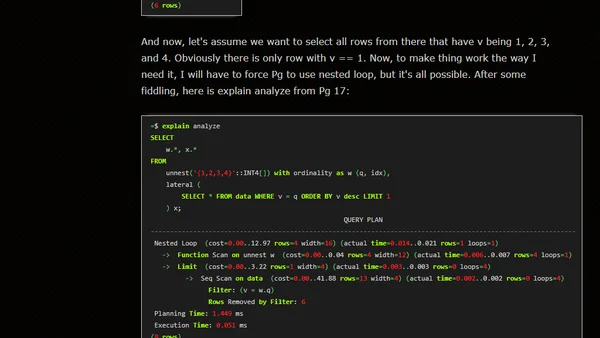
PostgreSQL 18 will improve EXPLAIN output by showing fractional row counts with two decimal digits for better query plan accuracy.
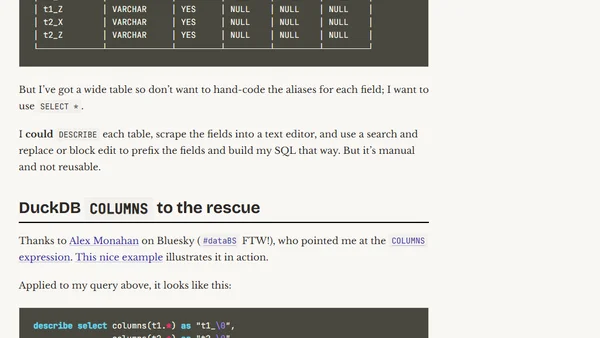
How to use DuckDB's COLUMNS expression to automatically rename fields when using SELECT * across joined tables, avoiding ambiguous column names.
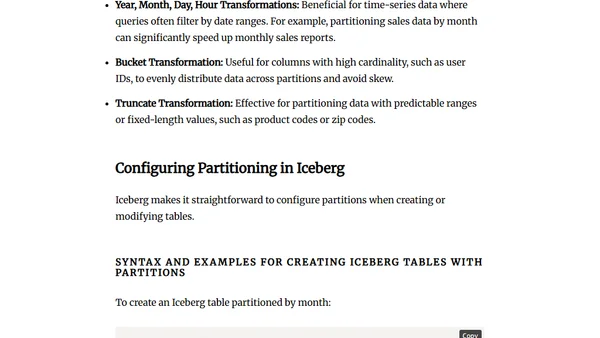
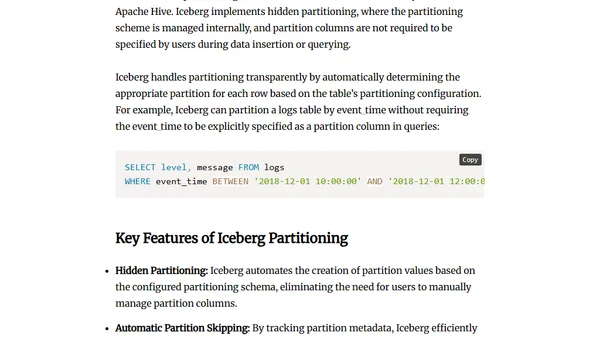
Explores Apache Iceberg's advanced partitioning features, including hidden partitioning and transformations, for optimizing query performance in data lakes.
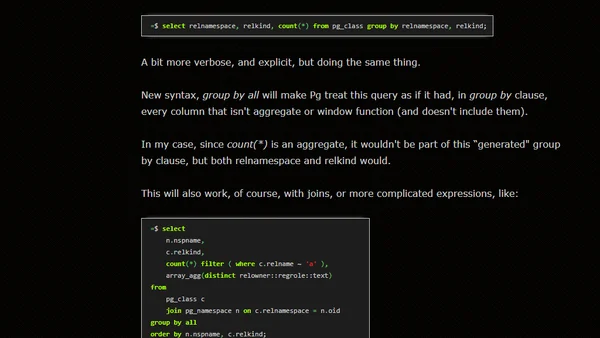
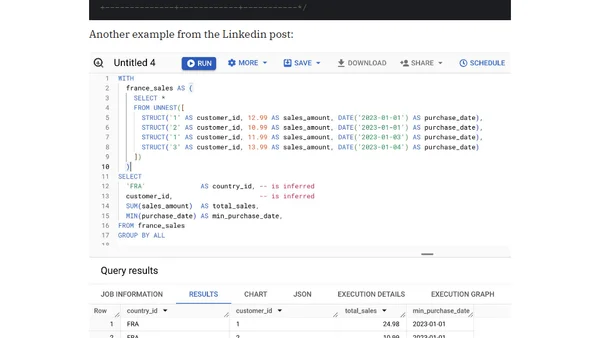
Introduces BigQuery's new GROUP BY ALL syntax, which automatically infers grouping keys from SELECT items to simplify complex SQL queries.
Explains a performance optimization technique for checking multiple row existence in SQL using LIMIT clauses, with benchmarks across RDBMS.
Compares partitioning techniques in Apache Hive and Apache Iceberg, highlighting Iceberg's advantages for query performance and data management.
Explains how jOOQ 3.19's implicit joins can automatically eliminate unnecessary table joins from SQL queries, improving performance.
jOOQ 3.19 introduces new explicit and implicit to-many path joins, simplifying SQL query syntax and improving readability and correctness.
Explains a common MySQL UPDATE error and provides a workaround using a derived table or jOOQ to bypass the restriction.
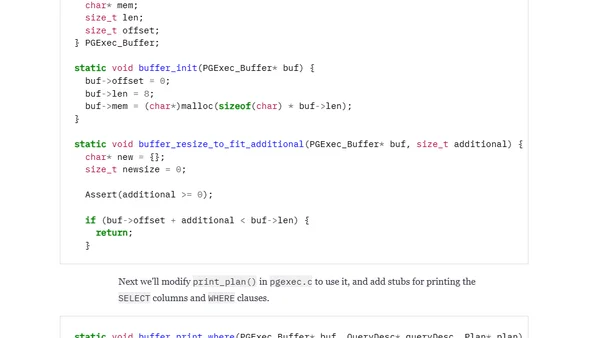
A technical deep dive into intercepting and walking PostgreSQL query execution plans to reconstruct SQL and enable custom evaluation.
Explains how PostgreSQL BRIN indexes can degrade performance despite high correlation and introduces the multi-minmax feature as a solution.
Explains the performance and readability benefits of ordering LINQ queries as Where.Select instead of Select.Where in C#.
A tutorial on writing derived tables in jOOQ, explaining syntax, type safety considerations, and questioning if a derived table is always necessary.