[Video] Office Hours: Car in the House Edition
Brent Ozar answers SQL Server questions in a video office hours session, covering topics like plan cache bloat, in-memory OLTP, index tuning, and more.
Brent Ozar explains why wide columns in SQL Server tables may not increase logical reads, using database animations and sp_tableoption.
Brent Ozar answers SQL Server questions on query plans, monitoring tools, AI, and more in a desert-themed Office Hours Q&A.
Analysis of why Clickhouse is winning the observability wars with columnar storage, handling massive data scales better than competitors.
Explains why SQL Server monitoring alerts alone are insufficient for stability, emphasizing interpretation and context.
Explores why SQL Server performance tuning often fails, focusing on systemic issues beyond indexes and queries.
SQL Server diagnostic queries for performance and configuration analysis, updated for April 2026.
Brent Ozar announces his upcoming sessions at the SQLBits conference, covering SQL Server performance tuning, indexing strategies, and cloud evolution.
Explains a SQL Server edge case where automatic statistics updates don't always invalidate cached execution plans, focusing on system-created stats.
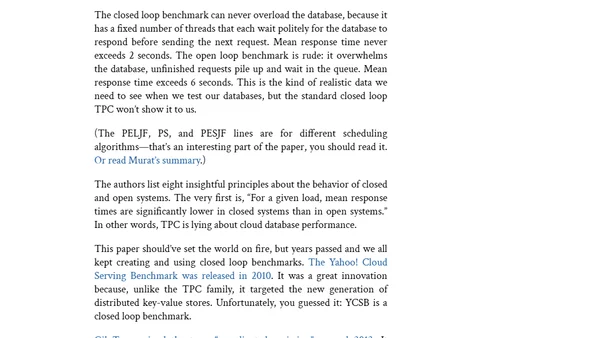
Argues that YCSB and TPC benchmarks are flawed because they use closed-loop models, and advocates for open-loop benchmarks to better simulate real-world cloud database workloads.
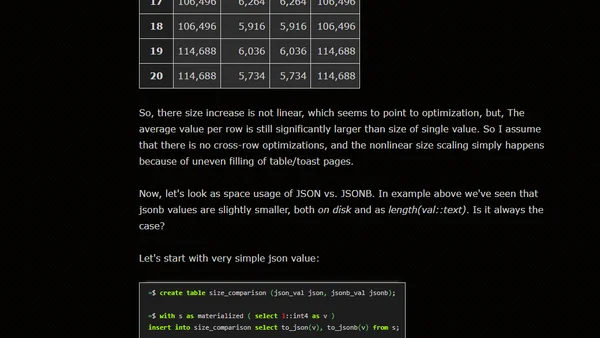
A technical analysis comparing PostgreSQL JSON storage options, compression methods (pglz vs. lz4), and performance optimizations.
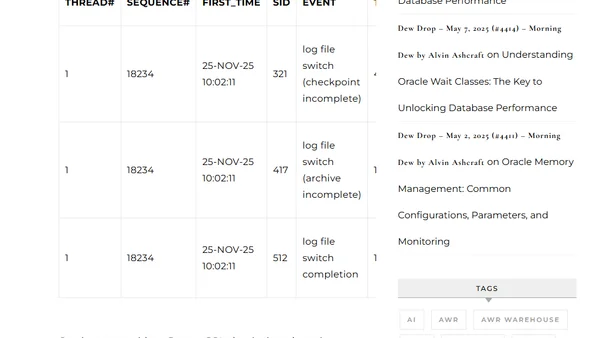
Compares PostgreSQL's pg_stat_wal metrics to Oracle's detailed redo logging instrumentation for database administrators.
A technical deep dive into how pgcat, a Postgres connection pooler, works by multiplexing client connections to improve performance and resource usage.
Updated T-SQL diagnostic queries for SQL Server (2005-2025) and Azure SQL to analyze instance configuration and performance.
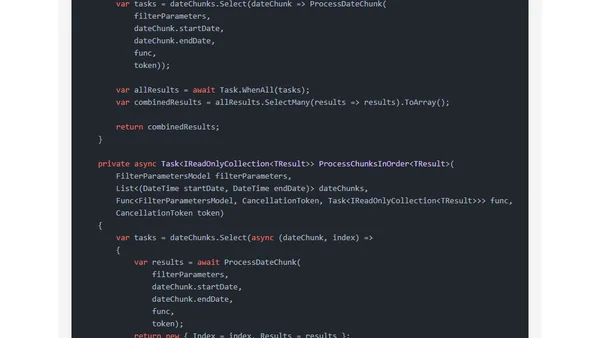
A developer shares techniques to improve database performance for large BLOB data retrieval in C#/.NET, including compression and chunking requests.
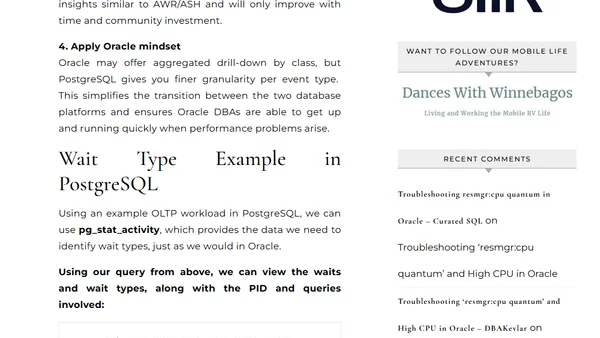
Compares Oracle and PostgreSQL wait analysis for database performance tuning, focusing on wait classes vs. event types.
A guide to troubleshooting and improving performance in slow SQL Server applications using structured techniques.
PostgreSQL 18 will introduce parallel CREATE INDEX for GIN indexes, significantly speeding up index builds on large tables.
Explores using Complex Types in Entity Framework Core 8 to reduce database tables, simplify data models, and improve performance.
Explains how PostgreSQL BRIN indexes can degrade performance despite high correlation and introduces the multi-minmax feature as a solution.