Trustworthy AI in the Agentic Lakehouse: Reconciling Concurrency and Isolation Contracts
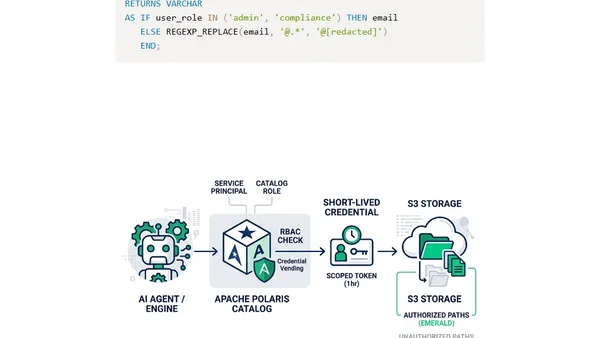
Explores concurrency and isolation challenges when multiple AI agents query a lakehouse, using Iceberg's optimistic concurrency control and access policies.
Explores achieving sub-second BI queries on Apache Iceberg data lakehouses by addressing object storage latency through file layout optimization and caching.
A step-by-step playbook for migrating from legacy data warehouses to open lakehouses, covering inventory, architecture, and trust-building.
Explores how Apache Iceberg decouples storage and compute for cost optimization, including multi-engine routing and TCO analysis.
Guide to securing Apache Iceberg tables with row/column-level access control using Apache Polaris and query engine policies.
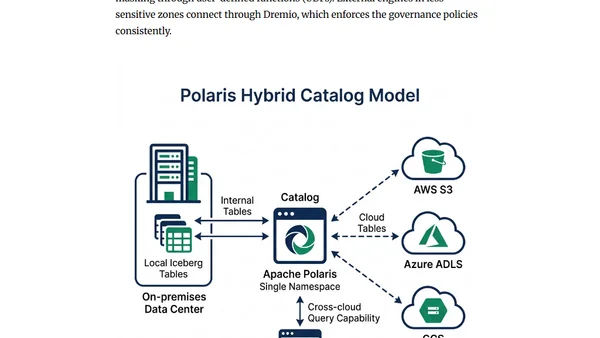
Explains how Apache Iceberg enables hybrid-cloud analytics for regulated markets by separating storage, compute, and catalog.
Comparison of Iceberg catalog control planes: Polaris, Unity Catalog, and Cloud REST for lakehouse architecture.
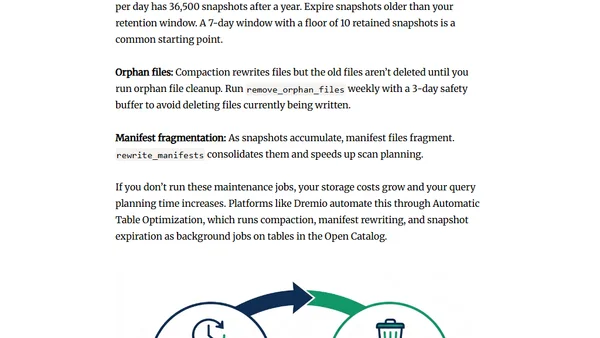
A guide on automating Iceberg table maintenance to prevent small file accumulation, covering compaction, vacuuming, and modern tools.
Explains how Apache Iceberg V3 improves CDC pipelines with deletion vectors and row lineage, solving delete file accumulation.
A technical guide on building real-time lakehouse architectures using Apache Flink 2.1 and the Dynamic Iceberg Sink, addressing schema drift, file proliferation, and operational rigidity.
Overview of Apache Iceberg 1.11.0 release, covering new features like metadata encryption, pluggable file formats, and query optimizations.
A curated list of interesting tech links for April 2026, covering data engineering, analytics, and AI integration.
A technical deep dive comparing metadata structures of modern table formats like Apache Iceberg, Delta Lake, and Hudi for data lakes.
Explains why table formats like Apache Iceberg and Delta Lake are essential for reliable data lakes, solving atomic commits, schema evolution, and time travel.
Explains how Apache Iceberg enables partition evolution without rewriting data, solving a major data lake challenge.
Explains how Apache Iceberg's hidden partitioning prevents accidental full table scans by automatically mapping source column filters to partition values.
Explains how Apache Iceberg table writes work, including commit steps and ACID guarantees on object storage.
Explains lakehouse catalogs in Apache Iceberg, their role in metadata management, and how to choose between open source and managed options.
Explains five ways Apache Iceberg table storage degrades over time, including small files, orphan files, and metadata bloat, with detection methods.
Strategies for migrating data to Apache Iceberg, including in-place, full rewrite, and shadow migration with zero downtime.