Optimizing an Advent of Code solution in assembly
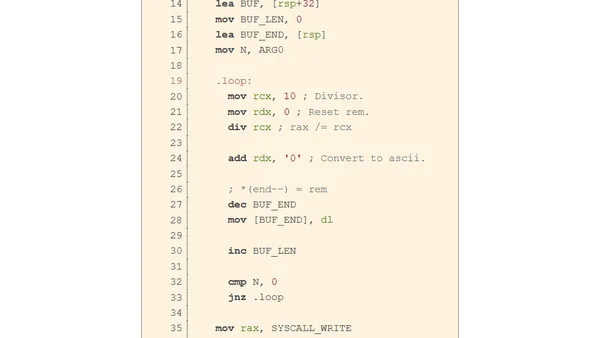
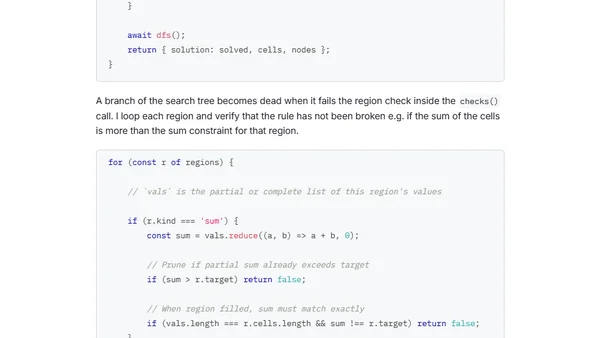
A developer revisits an Advent of Code puzzle, optimizing the solution with a new algorithm and implementing it in x86_64 assembly for performance.
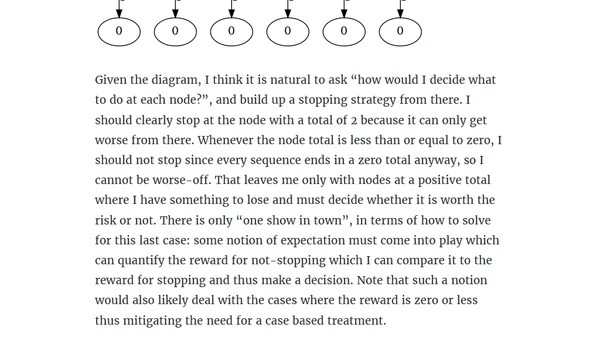
A detailed analysis of an optimal stopping problem involving drawing cards for reward, exploring mathematical strategies and first-principles reasoning.
A guide to solving the diagonal difference and sum problems for square matrices, with code examples in Java.
A developer recounts creating their first real app: a TI-83+ program to solve trigonometry homework, sparking a lifelong passion for programming.
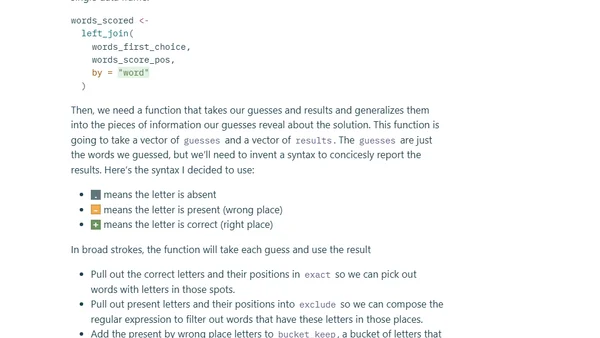
A blog post about creating a Wordle helper tool, discussing the programming challenges and educational opportunities the game presents.
A step-by-step algorithm to determine the value of the 'this' keyword in JavaScript functions, covering regular, arrow, and bound functions.
A guide to improving recursion skills by reimplementing standard library functions without using loops, with examples in JavaScript and Python.
A technical article comparing while and for loops in Python for finding numbers, with performance benchmarks and Python version considerations.
Explains how to efficiently parse a set of known strings in Elm by building a trie-like structure to avoid the performance pitfalls of Parser.oneOf.
A student's guide to creating generative scribble art portraits using the Processing programming language, detailing their algorithm and process.
Explains the APPROX_COUNT_DISTINCT function for faster, memory-efficient distinct counts in SQL, comparing it to exact COUNT(DISTINCT).
Analysis of a bug in New Zealand's official pseudo-random number generator used for electoral vote counting, based on the Wichmann-Hill algorithm.
Explains the Bailey-Borwein-Plouffe formula for computing hexadecimal digits of π and provides a Julia implementation.
Analyzes the pseudorandom number generator defined in NZ Flag Referendum law, comparing it to the Wichmann-Hill algorithm and noting a potential flaw.
A Rust programming simulation of the classic Monty Hall probability problem, demonstrating the counter-intuitive odds.
An explanation of the RANSAC algorithm for outlier rejection, used in computer vision and data modeling.
A developer shares their experience implementing the 8-puzzle solver in Rust using A* and BFS algorithms, discussing language features and challenges.