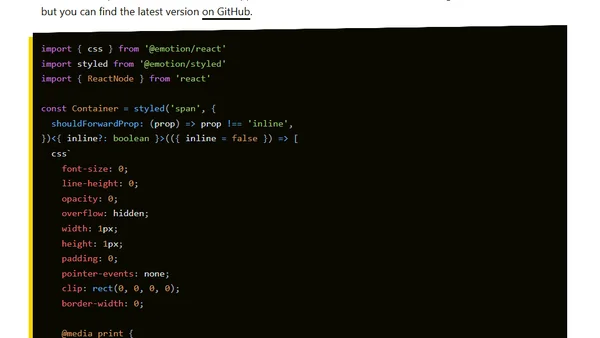
How to add copy-paste only text in HTML (plus a React component)
A guide to adding invisible text in HTML that only appears when copy-pasted, including a practical React component implementation.
A personal recap of FFConf 2024, covering talks on web development, AI ethics, accessibility, and the future of the conference.
A critique of React as legacy technology, arguing against its use in new projects due to performance and accessibility issues, and advocating for simpler client-side stacks.
Explores the role of empathy in design and the impact of personalized typography on accessibility and reading outcomes for diverse users.
Explores the historical misuse of the HTML <button> element, its critical role in web accessibility, and why developers often incorrectly use other elements instead.
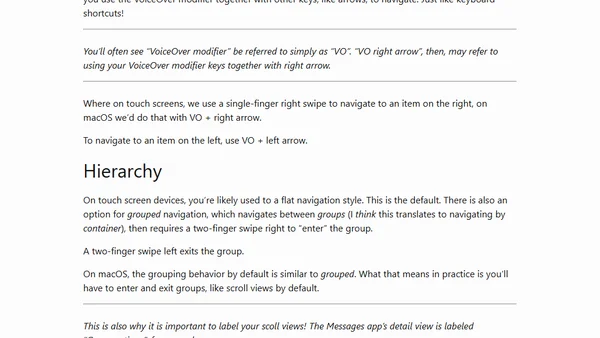
A guide to making digital accessibility easier for developers, focusing on SwiftUI, VoiceOver, Voice Control, and building an accessibility culture step-by-step.
A web developer reflects on common HTML mistakes, specifically the misuse of the <blockquote> element for pull-quotes and incorrect citation placement.
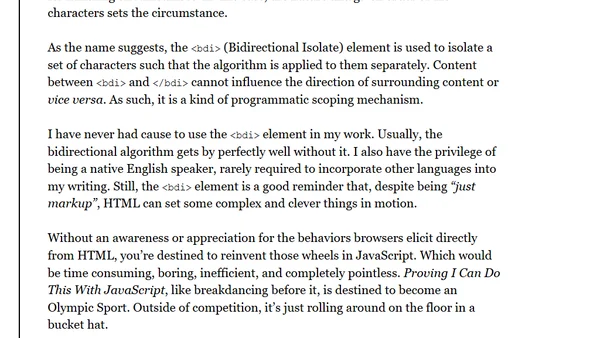
Explains the HTML <bdi> element and its role in isolating bidirectional text from the browser's Unicode algorithm.
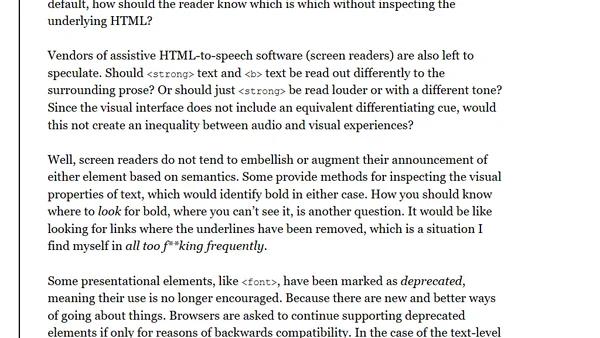
Explores the semantic evolution of the HTML <b> element from a presentational 'bold' tag to its current 'Bring Attention To' role, contrasting it with <strong>.
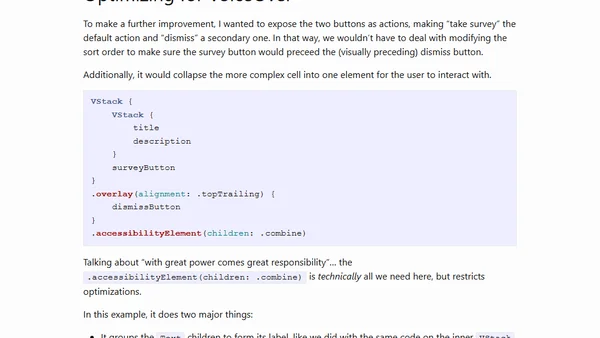
A developer's guide to optimizing iOS accessibility for VoiceOver and Voice Control, using a survey component as a practical example.
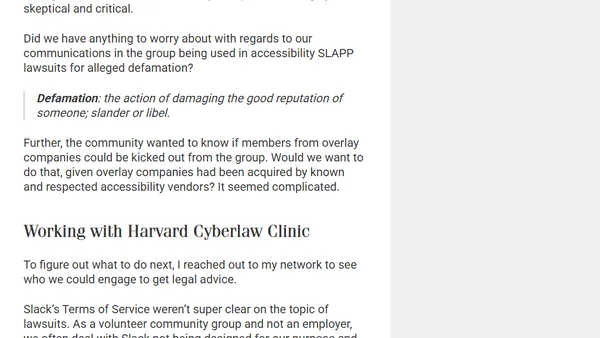
How the A11y Slack community developed anti-SLAPP policies with Harvard Cyberlaw Clinic to protect members from lawsuits by accessibility overlay vendors.
The article argues that choosing between dark and light mode should be based on ambient lighting and usability, not just personal aesthetic preference.
Explains the HTML <aside> element, its role as a sectioning element and landmark, and its relationship to ARIA's complementary role.
Explores the HTML5 <article> element, its purpose for document structure, and its importance for web accessibility and semantics.
An article explaining the HTML <abbr> element, its purpose for marking abbreviations, and a discussion on semantic HTML.
A developer shares his lightning talk on building accessible tab components using Web Components within a design system.
Introduces a Web Component for checking and displaying WCAG color contrast ratios and grades using CSS custom properties.
Exploring CSS Relative Colors to generate accessible text colors, comparing it to the upcoming contrast-color() function and discussing tradeoffs.
Explores using CSS Anchor Positioning and the Popover API to create interactive, accessible navigation menus without JavaScript.
A technical analysis of how modern screen readers interpret HTML tables with CSS Grid, ARIA roles, and complex attributes like rowgroup and colspan.