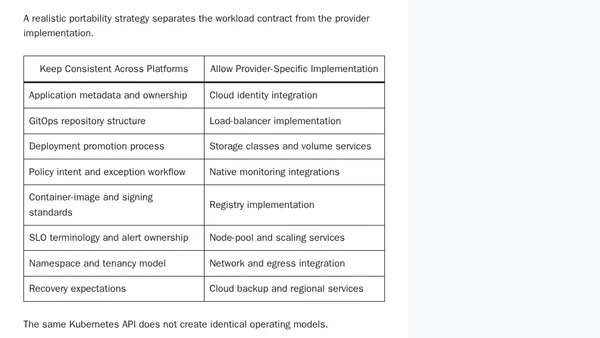
The Kubernetes Cathedral: Why Enterprise Cloud-Native Platforms Need More Than a Cluster
Explores why enterprise Kubernetes platforms require more than a cluster, covering identity, networking, GitOps, security, and governance.
Paul Bryant is a Principal Multicloud Architect at Dell Technologies, sharing expert insights on hybrid cloud, HCI, and enterprise IT transformation.
279 articles from this blog
Explores why enterprise Kubernetes platforms require more than a cluster, covering identity, networking, GitOps, security, and governance.
A runbook for validating GPUDirect RDMA and multi-node GPU performance with NCCL, covering topology mapping, RDMA testing, and baseline comparisons.
Explores VMware Cloud Foundation as a coordinated private cloud operating model, emphasizing workload mobility, automation, and resilience through integrated infrastructure components.
Explains VCF Automation marketplace as a governed self-service factory for application environments, focusing on operational contracts and platform products.
Troubleshooting guide for vSphere Supervisor deployment stuck at installing Kubernetes Node Agent, focusing on vLCM compliance issues per Broadcom KB 393663.
A guide to selecting and implementing AI gateway patterns for enterprises, covering API management, LLM proxies, edge gateways, and agent tool gateways.
Explores VMware Cloud Foundation multi-tenancy using a city metaphor, detailing how to design secure tenant neighborhoods on a shared platform.
Designing NSX microsegmentation with distributed firewall policy around applications, using a vault metaphor for workload isolation.
AI coding tools boost code volume but create operational bottlenecks in review, security, and ops, requiring new CIO metrics.
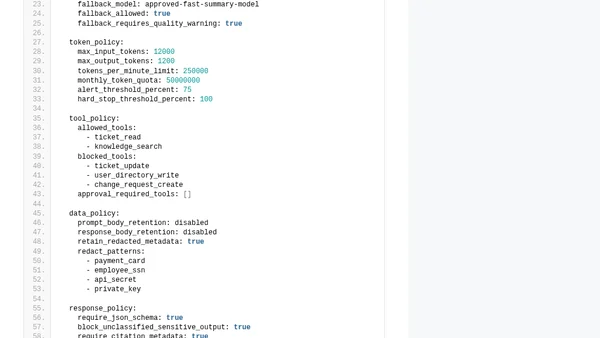
Learn how to build an operating model for AI gateways, covering identity, policy, observability, and cost controls for production readiness.
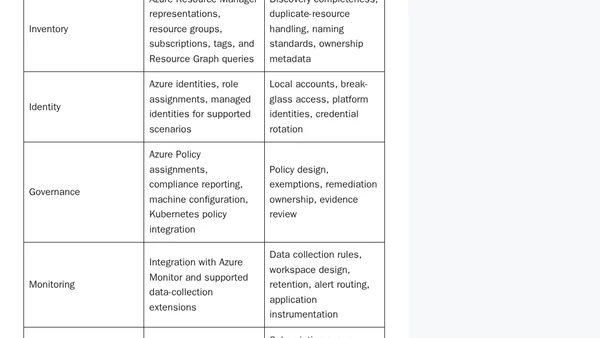
Microsoft Azure Arc extends Azure management to hybrid, multicloud, and edge resources, enabling a unified operating model for governance, security, and monitoring.
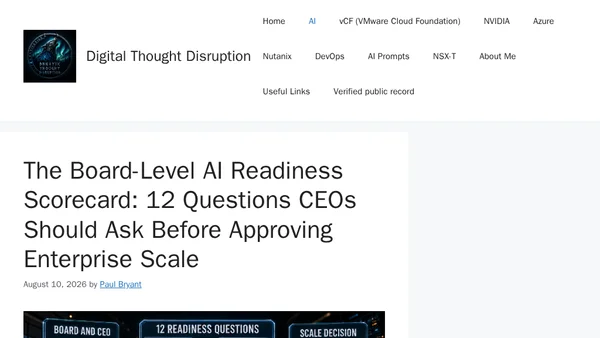
A scorecard with 12 questions for CEOs and boards to assess AI readiness before scaling enterprise AI initiatives, focusing on governance, value, and risk control.
AI gateways are becoming the control point for enterprise AI, handling identity, routing, governance, and observability.
This article discusses how CIOs should redesign IT operating models for AI-augmented work, emphasizing centralized control with federated business ownership and clear accountability boundaries.
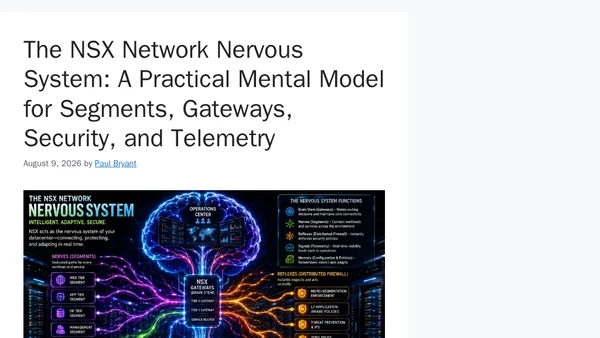
Explains NSX as a nervous system for network connectivity, covering segments, gateways, security, and telemetry with practical design insights.
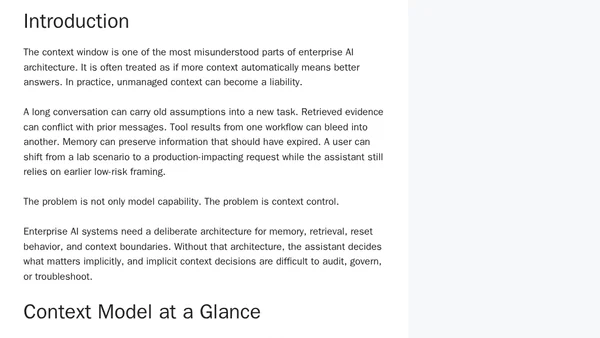
Explores how enterprise AI context windows need explicit memory, reset, and retrieval boundaries to prevent drift and errors.
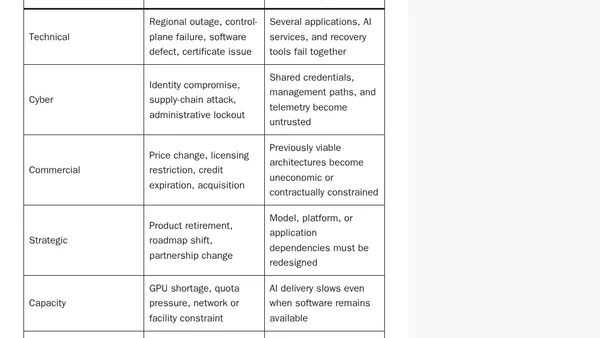
An analysis of technology concentration risk for CEOs and CIOs, covering AI, cloud, chips, and vendor dependency, with strategies for resilience.
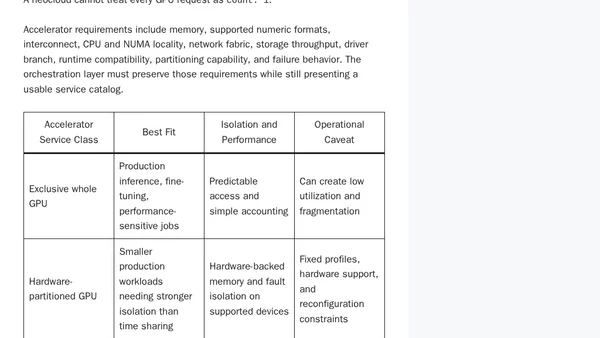
Explores why neoclouds need vendor-neutral AI infrastructure orchestration to differentiate beyond GPU capacity, focusing on lifecycle management and platform services.
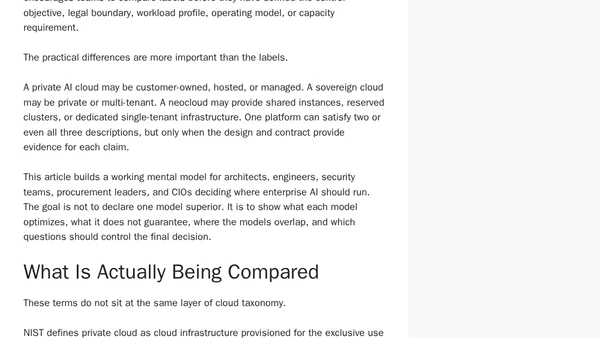
A practical guide comparing private AI cloud, sovereign cloud, and neocloud for enterprise AI infrastructure decisions.
This article explains how to build an IT AI insight engine that connects operational signals like tickets and incidents into a governed context layer for better decisions.