Virtual WAN Is Not Required For SD-WAN
Argues against using Azure Virtual WAN for SD-WAN implementations, citing complexity and limitations, and suggests alternative network architectures.
Extends an AI diagramming skill to generate AWS architecture diagrams using Draw.io MCP, improving on generic tools for clarity and reliability.
Explains Microsoft's Azure Virtual Network Routing Appliance (VNRA), its purpose, benefits for centralized traffic control, and initial testing insights.
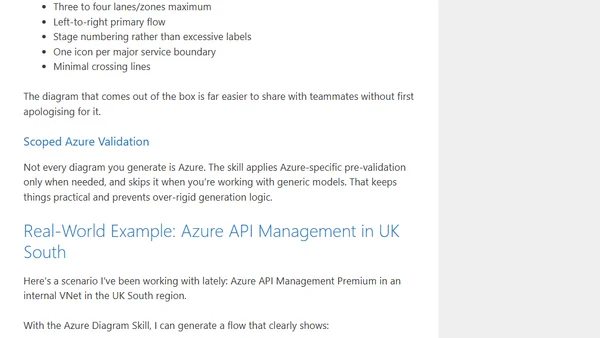
Introducing an Azure Diagram Agent Skill that uses Draw.io MCP and GitHub Copilot to automate the generation of consistent, readable Azure architecture diagrams.
Explores the trade-offs between reliability, security, cost, and other pillars when designing architectures using the Azure Well-Architected Framework.
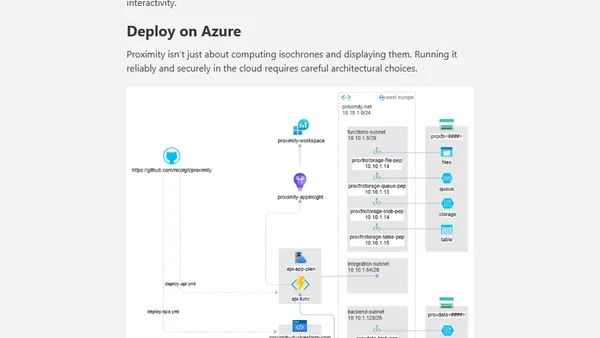
An architect details building Proximity, an open-source tool for visualizing walking-distance isochrones from public transport stops, as a sandbox for cloud architecture.
A technical analysis comparing the cost of different large-scale Azure network architectures, focusing on hub-and-spoke designs and Virtual WAN.
Explains the real-world responsibilities of an Azure Cloud Solutions Architect, focusing on strategic design, trade-offs, and documentation beyond just diagrams.
Explains how Azure AI Landing Zones provide a blueprint for scalable, secure AI solutions on Microsoft Azure, covering architecture and deployment.
Introduces the Azure Local Well-Architected Review Assessment, a tool to evaluate and improve hybrid cloud architecture based on Microsoft's framework.
Analyzes the unique trade-offs in serverless architecture, proposing a new model beyond the classic cost-performance-reliability trilemma.
A guide to planning and designing a hub and spoke cloud network architecture, focusing on principles like resilience, micro-segmentation, and cost management.
Analyzing how the Azure Verified Module for AKS aligns with the Well-Architected Framework's pillars for secure, reliable, and cost-optimized Kubernetes deployments.
A guide to designing a hub virtual network for a secure hub & spoke architecture in Microsoft Azure, focusing on core principles and functions.
Explains why traditional DMZ and secure zone network designs offer little security in Azure, advocating for modern micro-segmentation approaches.
Explains how Azure Proximity Placement Groups reduce latency for sensitive applications, with test results and considerations.
Introducing Azure Extended Zones, a new capability to deploy compute, storage, and select Azure services closer to users in metropolitan areas like Los Angeles.
A summary of Dr. Werner Vogels' re:Invent 2024 keynote on system design principles like evolvability, decomposition, and cell-based architectures.
Summary of AWS re:Invent 2024 Day 4, covering Werner Vogels' keynote on simplicity vs. complexity and technical sessions on serverless and DynamoDB.
Explains Azure Geo-Redundant Storage (GRS) patterns and key considerations for designing workloads with Business Continuity and Disaster Recovery (BCDR) in mind.