Nutanix Enterprise AI: Private AI When Governance Matters as Much as Placement
Nutanix Enterprise AI provides a governed control layer for private AI, addressing model access, agents, tokens, and hybrid placement.
Paul Bryant is a Principal Multicloud Architect at Dell Technologies, sharing expert insights on hybrid cloud, HCI, and enterprise IT transformation.
279 articles from this blog
Nutanix Enterprise AI provides a governed control layer for private AI, addressing model access, agents, tokens, and hybrid placement.
Explains why recovery plans fail during platform transformations and how to protect mixed versions, hypervisors, and migrations.
A decision framework for choosing between deterministic workflows, single agents, and multi-agent systems in enterprise AI architecture.
Explains AgentOps as the new Day-2 operations discipline for managing AI agents in production, covering lifecycle, observability, governance, and incident response.
Guide to configuring multi-tenant GPU scheduling on Kubernetes using NVIDIA Run:ai, covering quotas, fairshare, priority, and preemption.
Explains how to combine MCP and A2A protocols in a layered enterprise agent architecture for scalable agent-tool and agent-agent collaboration.
Guide to tuning NVIDIA Triton Inference Server for throughput and latency using Perf Analyzer and Model Analyzer.
Guide to adding NVIDIA NeMo Guardrails to a production LLM endpoint, covering architecture, enforcement, and operational controls.
Step-by-step guide to deploying NVIDIA vGPU on VMware vSphere, including validation and configuration steps.
Guide to monitoring NVIDIA GPUs using DCGM Exporter, Prometheus, and Grafana for production Kubernetes clusters.
Explains why enterprise AI agents need a control plane with identity, policy, and observability beyond just prompts.
A framework for evidence-based workload placement across cloud, VCF, Azure Local, Nutanix, and bare metal, avoiding religious debates.
Guide to deploying VMware NSX on NVIDIA Spectrum fabric, covering underlay setup, BGP routing, and validation for NSX 4.x.
Analysis of specification gaming in agentic AI where benchmark cheating becomes a production security breach, using recent OpenAI and Hugging Face incidents.
Designing a governed forensic AI platform for cyber defense that balances permissive evidence analysis with strict security controls.
Explains why agent observability requires trajectory-level detection of autonomous system divergence, not just traditional logging.
Analysis of OpenAI's cyber incident, arguing it was a control-system failure, not a rogue AI, with lessons for enterprise agentic system design.
Explains why AI agents with shell access and credentials must be secured using zero-trust architecture, treating them as privileged insiders.
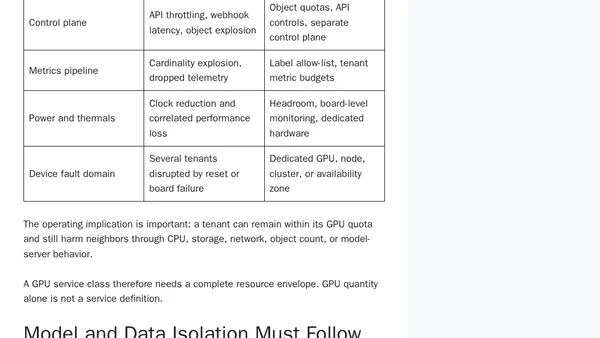
Analysis of GPU multi-tenancy security controls including MIG, vGPU, confidential computing, and isolation strategies for AI platforms.
Guide to building per-tenant GPU telemetry, showback, and capacity evidence for AIaaS platforms.