A look at the internals of 'boxing' in the CLR
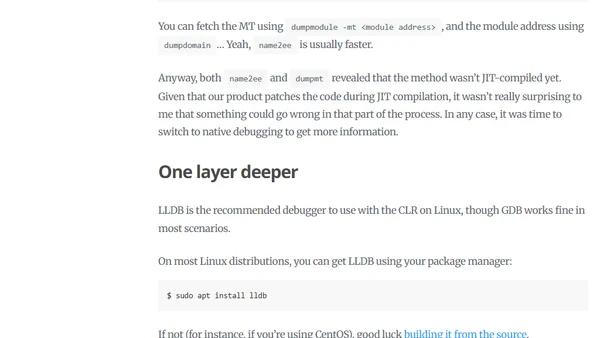
Explains how boxing works internally in the .NET CLR, covering type creation, IL code, and JIT compilation.
Explains how to properly retrieve the current culture in UWP apps using a non-hacky method based on .NET Core Runtime internals.
A technical overview of new features in C# 7, including pattern matching, tuples, out variables, and local functions.
Announcing FakeItEasy 3.0.0, a .NET mocking framework update with .NET Core support, new syntax, and improved features.
Explains how .NET delegates work internally, including their CLR implementation, IL representation, and runtime behavior.
A technical analysis comparing pause times in .NET's Workstation and Server Garbage Collection modes using a standardized benchmark.
A technical guide on using Microsoft's ClrMD library to inspect and analyze the .NET managed heap, including memory structures and debugging techniques.
Explains why exceptions in .NET should be rare, comparing them to asteroid strikes, and analyzes their performance costs versus error codes.
Explores why reflection in .NET is slow, examining CLR design goals, internal data structures, and the multi-step invocation process.
Explores academic research papers referenced in the .NET runtime and compiler source code, focusing on data structures and optimization algorithms.
Analyzes community and Microsoft contributions to open source .NET repositories over two years, showing trends in issues and pull requests.
A utility for dynamically reading nested property values from objects using string-based configuration, useful in asynchronous services.
Explains how the .NET Garbage Collector works and provides techniques to reduce memory allocations for faster applications.
Author announces participation in Xamarin Dev Days Singapore, discussing Xamarin.Forms and Azure integration for mobile development.
A personal recap of the 2016 Porto Tech Hub conference, highlighting its community atmosphere and the collaborative Porto tech scene.
Explores the System.Runtime.CompilerServices.Unsafe API in .NET for low-level, high-performance pointer manipulation while bypassing standard type safety.
A guide to using the dotnet watch tool for automatic application restarts during .NET development, including setup and Visual Studio integration.
A guide to analyzing .NET memory dumps using the CLR MD library, covering heap inspection and string analysis.
A technical analysis of performance optimizations in the .NET Wire serialiser library, using BenchmarkDotNet to measure the impact of each change.
Explores the new tuple deconstruction feature in C# 7, including syntax and how to deconstruct custom types.