It’s Not About Morals: Accessibility is for the Masses
Argues that web accessibility benefits all users, not just those with disabilities, and improves business outcomes by reaching a wider audience.
Critique of the role="password" ARIA attribute, arguing it undermines security, accessibility, and user experience by enabling poorly implemented custom password fields.
A curated list of essential web accessibility resources, tools, books, and courses for designers and developers.
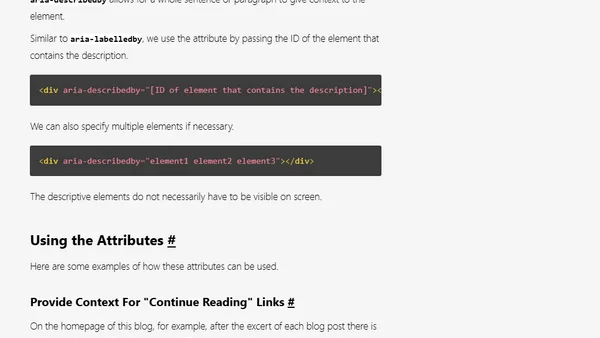
Explains how to use ARIA attributes (aria-labelledby, aria-label, aria-describedby) to properly label HTML elements for screen readers and improve web accessibility.
A developer's personal recap of attending the CSUN 2014 conference, focusing on learning about web accessibility, ARIA, and meeting experts in the field.
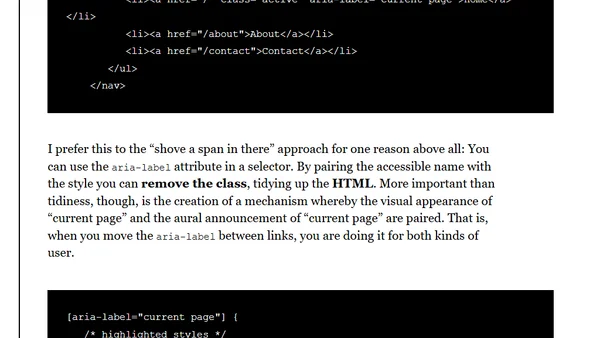
Explores the accessibility challenge of indicating the current page link in web navigation, discussing solutions like hidden spans and ARIA labels.
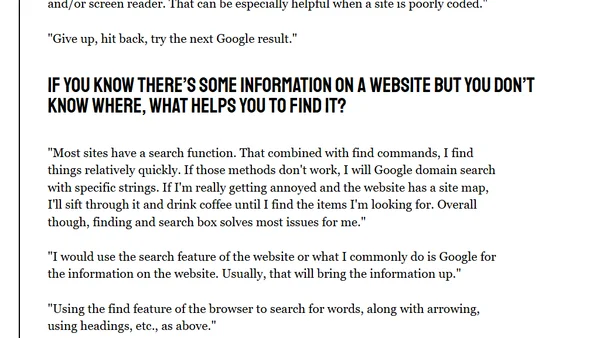
A discussion on web accessibility for developers, emphasizing the need for practical implementation over theory and the importance of keyboard navigation.
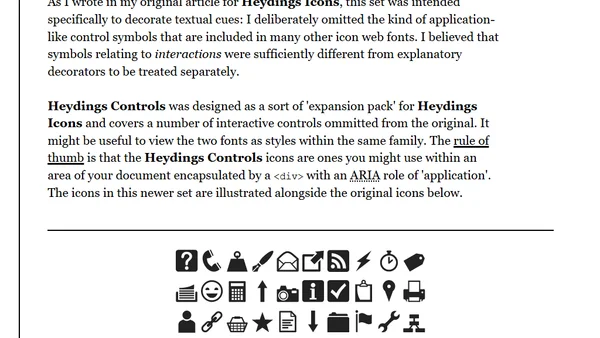
Introducing Heydings Controls, a companion icon font for interactive UI elements, designed as an expansion to the free Heydings Icons font.
A discussion on the practical value of HTML semantics, focusing on accessibility and the real-world impact of semantic markup on screen readers.
A guide to designing a highly usable and accessible slider control for web interfaces, focusing on user experience and ARIA compatibility.
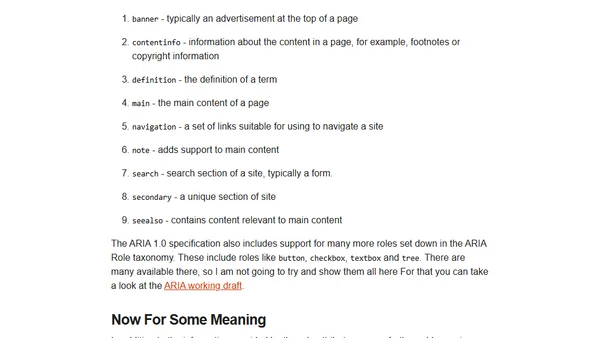
An introduction to ARIA (Accessible Rich Internet Applications) for adding semantic meaning and improving accessibility in dynamic web interfaces.