Linear Diffusion: Building a Diffusion Model from linear Components
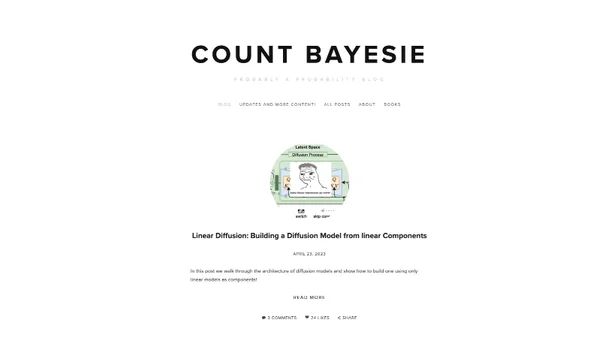
Introducing Linear Diffusion, a novel diffusion model built entirely from linear components for generating simple images like MNIST digits.
Will Kurt is a data scientist and author writing about probability and statistics through his blog Count Bayesie. He explores Bayesian and frequentist methods with an intuitive, insight-driven approach, making complex ideas in probability accessible and engaging.
18 articles from this blog
Introducing Linear Diffusion, a novel diffusion model built entirely from linear components for generating simple images like MNIST digits.
Explores using GPT-3 text embeddings and a simple classifier to predict the winner of a headline A/B test, potentially replacing traditional testing.
Explores convolutions in probability theory, explaining how they combine distributions and compute sums of random variables.
A statistical analysis of estimating a normal distribution using binary (yes/no) predictions from multiple scientists, applied to a temperature forecasting problem.
A technical tutorial on applying Modern Portfolio Theory for investment optimization using JAX and differentiable programming.
Explains how to apply Bayesian thinking and probability to critically analyze news articles and identify underlying biases.
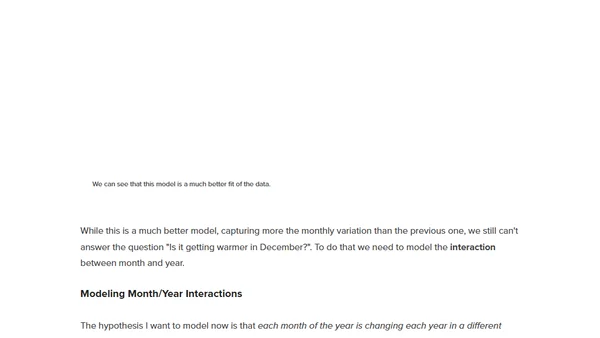
A data scientist uses NOAA data and statistical modeling to analyze if December temperatures in New Jersey are truly warming over time.
Explores the logit-normal distribution, its mathematical properties, and its surprising role in statistical models like logistic regression.
Explores practical differences between Bayesian and Frequentist statistical methods using a sci-fi probability problem.
Explores the connection between machine learning and statistics by building a statistical inference model from a neural network example.
Explores the difference between inference and prediction in data modeling, using a Click Through Rate (CTR) example to contrast Machine Learning and Statistics.
A technical tutorial using Python and JAX to model and correct for survivorship bias in housing market data during the pandemic.
A technical tutorial on implementing Thompson Sampling to optimize ad auction decisions by balancing bid values and click-through rates.
Explains why Monte Carlo simulation is essential for Bayesian hypothesis testing, using A/B testing and election forecasting as examples.
A tutorial on Probability and Statistics concepts, from basics to generalized linear models, presented at PyData NYC with Python examples.
Explains how prior probabilities are learned and updated in logistic regression models, using a coffee brewing example to illustrate class imbalance.
Explains the mathematical derivation of logistic regression from Bayes' theorem, connecting fundamental statistics to machine learning.
A technical exploration of Mean Squared Error, breaking it down into bias and variance to understand model performance and irreducible uncertainty.