15 rules for communicating at GitHub
GitHub shares 15 rules for effective asynchronous communication and collaboration in a distributed, tech-focused workplace.
Ben Balter writes about technology leadership, open source, and modern collaboration at scale. His essays blend engineering mindset with management, community building, remote work, and transparent communication—shaped by years of experience at GitHub and in public-sector tech.
183 articles from this blog
GitHub shares 15 rules for effective asynchronous communication and collaboration in a distributed, tech-focused workplace.
A former government developer and attorney analyzes outdated federal IT workflows and advocates for adopting modern, open-source practices and updating laws.
Explains the role of a Government Evangelist at GitHub, focusing on helping government agencies adopt open source software and practices.
A guide for government attorneys on open source software licensing, covering common licenses, legal issues, and best practices for agency participation.
Explains why government contractors should adopt open source software for cost savings, best practices, and competitive advantage.
Explores the critical importance of URLs for collaboration, institutional knowledge, and transparency, especially in tech and government contexts.
Critique of outdated government software procurement practices and the need to adopt modern version control and delivery methods.
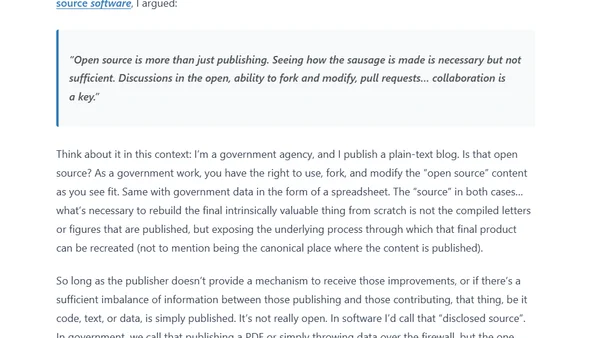
Explains why simply releasing government source code isn't true open source, which requires licensing, community, and collaboration.
Debunks the myth that open source software is inherently insecure, comparing it to proprietary alternatives and explaining its security advantages.
A former government employee compares bureaucratic culture at a federal agency with the trust-based, developer-happy environment at GitHub.
Explores the reasons why government software is often closed-source, examining procurement practices, vendor influence, and cultural barriers to open source adoption.
Critique of FedRAMP's cloud security framework, arguing it creates bureaucratic barriers that hinder government adoption of innovative, cost-effective cloud solutions.
A follow-up analysis of U.S. federal .gov domains, tracking changes in technology, security, and accessibility over three years.
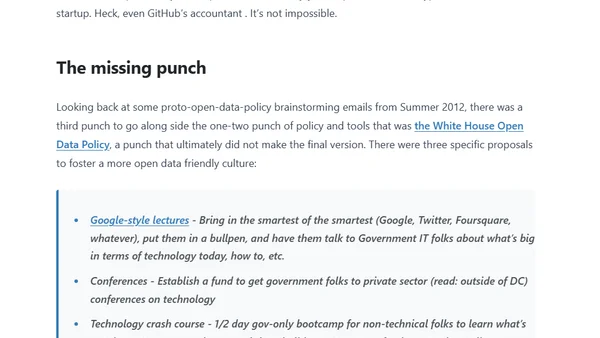
Argues for moving beyond open government to collaborative government, using open source software development as a model for public participation.
A guide to evaluating the health and sustainability of open source projects before adopting them, covering metrics like activity, community, and documentation.
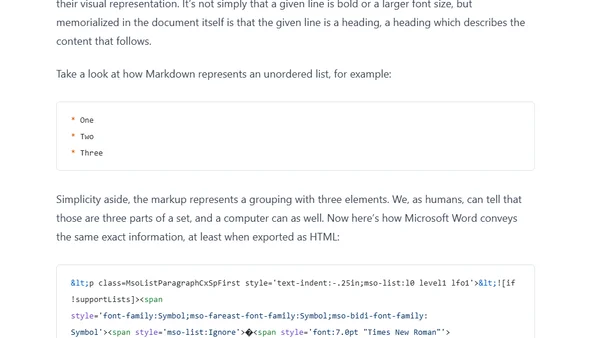
Explores the fundamental differences between Word and Markdown, arguing Markdown's semantic nature is better suited for web content creation.
Argues that successful government tech innovation depends more on changing bureaucratic culture than on implementing new technology.
A tutorial on adding GitHub-style hover anchor links to headings on a Jekyll-based GitHub Pages site using CSS and JavaScript.
Explores the evolving definition of open source, debating whether it's about collaborative contribution or the right to freely modify software.
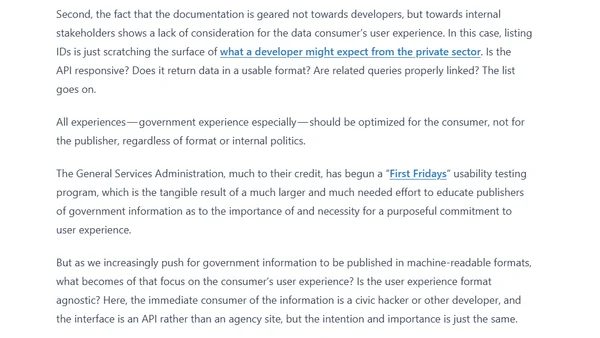
Analyzes why government open data initiatives fail due to poor API design and documentation that ignores developer needs.