

Consecutive Pythagorean triangle sides
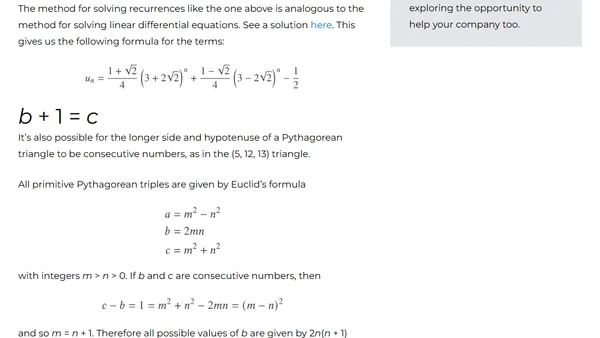
Read OriginalThis article examines Pythagorean triples where the sides are consecutive integers, specifically cases where a+1=b or b+1=c. It references George Osborne's 1914 paper proving that the sequence of shorter legs for consecutive-leg triples follows a recurrence relation (OEIS A001652) and provides a closed-form solution. It also covers triples where the longer leg and hypotenuse are consecutive, derived from Euclid's formula with m=n+1. The content is mathematical and number-theoretic, relating to computer science algorithms and integer sequences.
Comments
No comments yet
Be the first to share your thoughts!
Browser Extension
Get instant access to AllDevBlogs from your browser
Top of the Week
No top articles yet