The Agent Action Evidence Contract: What Every AI Action Must Record
TL;DR The Agent Action Evidence Contract defines what a consequential AI action must record, which component is responsible for each fact, and what ev
Paul Bryant is a Principal Multicloud Architect at Dell Technologies, sharing expert insights on hybrid cloud, HCI, and enterprise IT transformation.
279 articles from this blog
TL;DR The Agent Action Evidence Contract defines what a consequential AI action must record, which component is responsible for each fact, and what ev
TL;DR The Assurance Independence Model evaluates whether the mechanisms overseeing an AI agent can fail, be manipulated, or be overridden through the
TL;DR The strongest way to understand NSX security is not as a bigger firewall at the edge, but as a control fabric that turns workload context into d
TL;DR AI feedback loops do not improve a system merely by preserving more outputs. An unsupported explanation can return through retrieval as apparent
TL;DR AI uncertainty is not one measurement. Token entropy describes prediction variability, semantic entropy examines variation in meaning, and calib
TL;DR AI output verification should assess specific claims against appropriate evidence, not assign a blanket trust score to a polished response. Sepa
TL;DR Hybrid cloud operations become fragile when teams connect products without agreeing which system owns each decision. Coordinate Dell infrastruct
TL;DR Repetition can make an explanation familiar without making it correct. In AI-assisted operations, a tentative diagnosis can spread through ticke
TL;DR An enterprise request is not complete when compute and storage have been provisioned. Capacity, security, sovereignty, recovery, observability,
TL;DR Global Workspace Theory in AI offers a useful architectural lens: specialized components process information locally, selected information enter
TL;DR Hybrid cloud becomes difficult to operate when several platforms appear to own the same lifecycle, identity, or policy decision. Define the resp
TL;DR An AI agent is not dependable simply because it can reason, call tools, and retry. It needs a feedback architecture that connects an approved go
VCF 9.1 autonomous operations: bounded autonomy, telemetry, policy, and verified recovery for private cloud.
Explores how behaviorism and reinforcement learning shape AI behavior, and why rewards don't guarantee intended outcomes in enterprise AI systems.
Designing sovereign private AI with VMware Cloud Foundation: boundaries, controls, and ownership for enforceable governance.
AI confidence calibration vs. evidence qualification: an evidence contract pattern to ensure agent claims are supported by authentic, relevant data.
Connectionism in AI: how neural networks learn relationships, and what that means for enterprise AI architecture and controls.
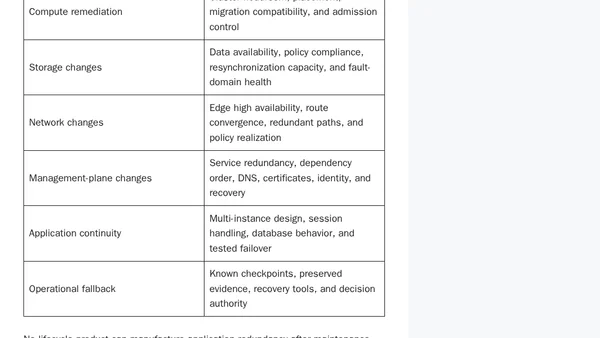
Explains VMware Cloud Foundation lifecycle management as a coordinated operating loop, covering VCF 9.1 capabilities and the limits of zero downtime.
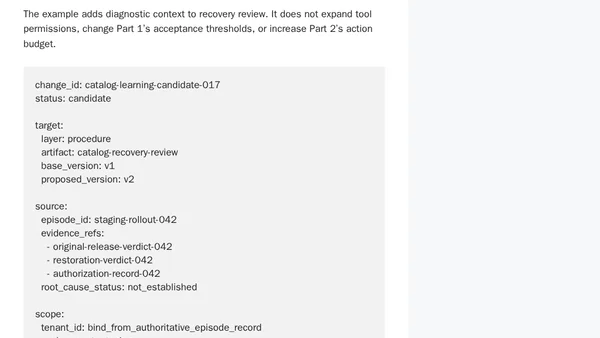
AI agent learning: governing durable changes via provenance, scope, evaluation, approval, and revocation.
AI decision controls: separating model proposals from authorized actions with evidence, permissions, and verification.