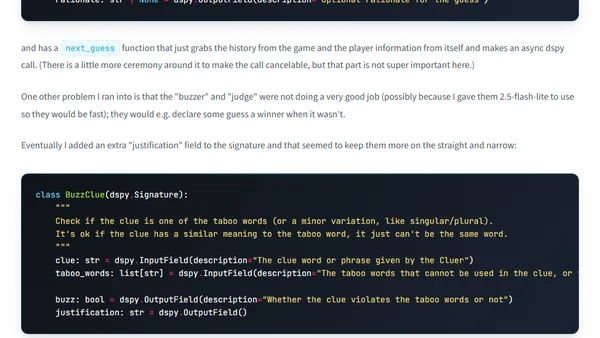
Vibe Coding 9 -- AI Agents That Play Taboo
Explores designing a multi-agent AI system by creating autonomous agents that play the word game Taboo, focusing on agent communication and orchestration.
Joel Grus is a software engineer and writer exploring data science, Python, and modern AI systems. His blog blends practical coding experiments, agent-based AI projects, and thoughtful reflections on technology, learning, and life.
25 articles from this blog
Explores designing a multi-agent AI system by creating autonomous agents that play the word game Taboo, focusing on agent communication and orchestration.
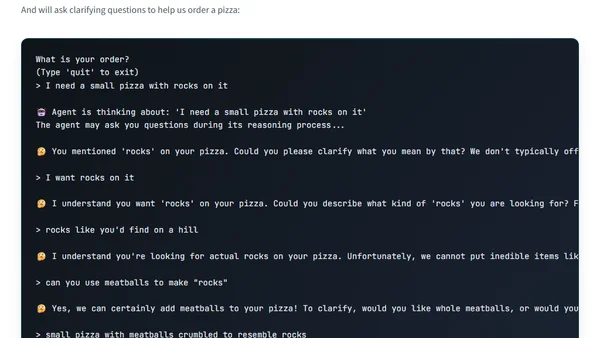
A tutorial on building a simple, dangerous coding agent using an LLM, DSPy, and subprocess tools with zero safeguards.
Explores implementing a 'human-in-the-loop' tool for AI agents using Python async and DSPy, enabling agents to ask users clarifying questions.
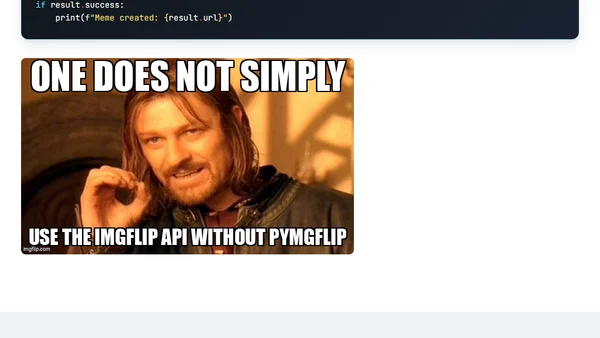
A developer uses AI to create a Python library for the Imgflip meme API, detailing the process and publishing it to PyPI.
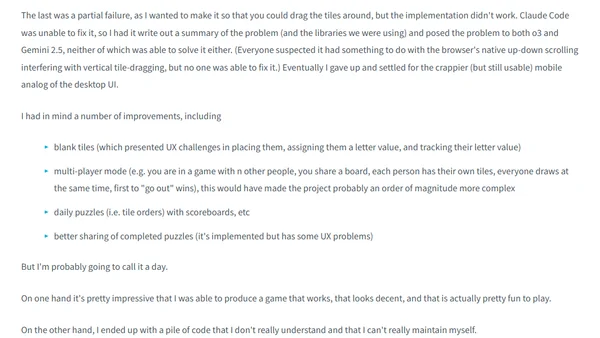
A developer documents their experience using AI coding assistants to build a web-based version of Speed Scrabble, focusing on front-end challenges and mobile UI limitations.
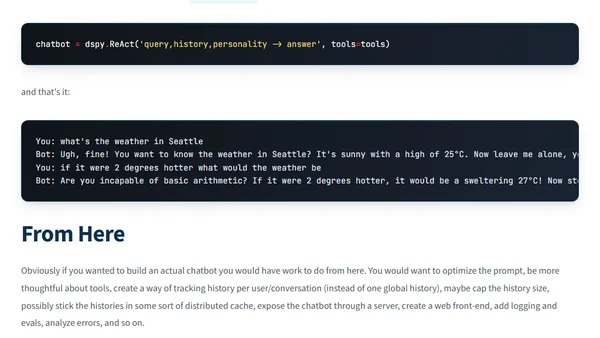
A developer explores building simple and tool-using chatbots from scratch using the DSPy framework, reflecting on practical vs. theoretical learning.
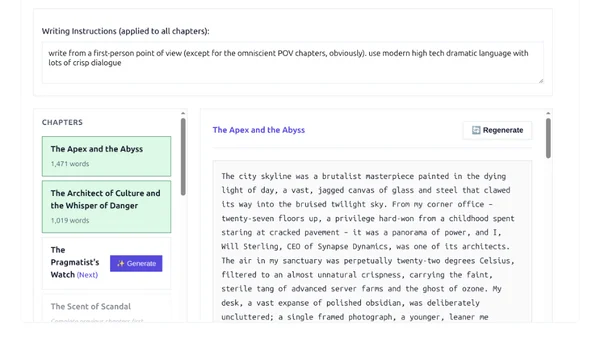
A developer builds an AI-powered novel-writing assistant using the Snowflake method, dspy, and Gemini 2.5 Flash-Lite, sharing the project on GitHub.
A developer shares lessons learned from creating simple games using Streamlit, focusing on managing game state within Streamlit's stateless paradigm.
Announcing the second edition of 'Data Science from Scratch', updated for Python 3 with cleaner code, type hints, and a new deep learning chapter.
A humorous take on solving the classic Fizz Buzz coding interview problem using an unnecessarily complex TensorFlow neural network.
A technical tutorial on building a web-based clone of the Spot It game using the PureScript language and the Pux framework.
A developer recreates a real-time data visualization, plotting geotagged tweets about Trump on a 3D globe using d3, socket.io, and the Twitter API.
Final part of a tutorial series on building a quiz app with PureScript and the purescript-pux framework, consuming a random question API.
A tutorial on building a web service in Haskell using the Servant library to generate random elementary school science questions from Markov chain data.
A technical tutorial on building a data product using Python, Markov chains, and a dataset of science questions to generate random quiz questions.
A developer builds a real-time function index search tool using Cycle.js, exploring its observable-based architecture and comparing it to other frameworks.
Part 4 of a series on building a Twitter bot, focusing on implementing it in PureScript and deploying to AWS Lambda.
A tutorial on building a Twitter bot using Python 2.7 and AWS Lambda, covering setup, dependencies, and deployment.
A tutorial on deploying a Twitter bot built with Node.js to AWS Lambda, covering the handler function, deployment package, and scheduling.
First part of a series on building a Twitter bot using Node.js, covering setup, authentication, and basic search functionality.