Why Your GPU Is Idle: A Layer by Layer Troubleshooting Guide for Enterprise Inference
A troubleshooting guide for diagnosing why GPUs remain idle during enterprise inference, focusing on systematic root-cause analysis.
Paul Bryant is a Principal Multicloud Architect at Dell Technologies, sharing expert insights on hybrid cloud, HCI, and enterprise IT transformation.
279 articles from this blog
A troubleshooting guide for diagnosing why GPUs remain idle during enterprise inference, focusing on systematic root-cause analysis.
Explains how MCP and A2A protocols fit into an enterprise agent architecture, with MCP for tool access and A2A for agent-to-agent delegation.
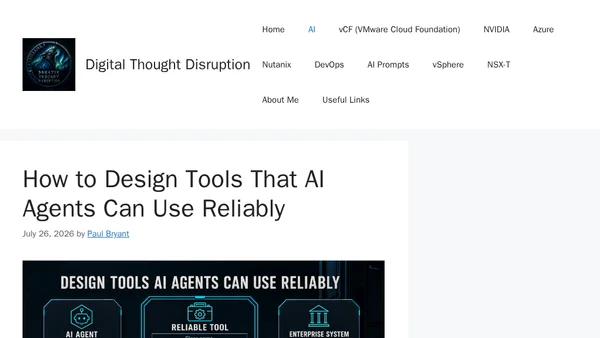
A tutorial on designing reliable AI agent tools with clear naming, schemas, error handling, and evaluation.
Analysis of VMware Cloud Foundation 9.1 minimum requirements beyond host count, covering storage, NSX, licensing, and operational overhead for production readiness.
A guide to building enterprise RAG systems that prioritize evidence over confident answers, covering retrieval, reranking, and citation validation.
Explains how to protect GPU-backed workloads where snapshots and VM mobility have limits, using layered recovery strategies.
Implementation guide for human review systems in AI agent workflows, focusing on enforcement points and audit trails.
Analysis of true private GPU costs vs. public cloud for enterprise AI FinOps, including depreciation, power, and utilization.
Introduction Enterprise GPU design becomes confused when several different decisions are compressed into one question: “How should we share the GPU?”
VCF 9.1 creates a familiar operational trap: a platform team can complete a release-note review and still not be ready to upgrade. The reason is that
Introduction The phrase “import an existing vCenter” sounds safer than it really is. It suggests that VMware Cloud Foundation reads an inventory, regi
TL;DR An agent action is not complete when the MCP server returns a successful response. It is complete only when the runtime proves that the intended
TL;DR An expected workload count is not a GPU requirement. Thirty concurrent notebooks, RAG services, inference endpoints, fine-tuning jobs, or distri
TL;DR A multivendor private AI platform is not operationally complete when the hardware is installed, the GPUs are visible, and the first model endpoi
TL;DR Sensitive data protection for AI is not a prompt-writing problem. It is a data-path control problem. The safest operating model classifies data
A risk model is only useful if it changes what happens before the agent acts. The Agent Blast Radius Model gives teams a way to classify AI agent acti
Analysis of VMware Cloud Foundation 9.1 release notes, focusing on architectural changes, infrastructure efficiency, and operational impacts for IT operators.
This article explains how to govern MCP gateways and server layers in enterprise agent control planes, focusing on security, admission, and routing.
Guidance on choosing isolation boundaries in VCF 9.1, comparing NSX VPCs, workload domains, and other options to avoid over-engineering.
Explains how to design AI storage architecture using PowerScale, PowerFlex, vSAN, object storage, and local NVMe based on data lifecycle.