Technically Speaking - Anniversary Mentoring
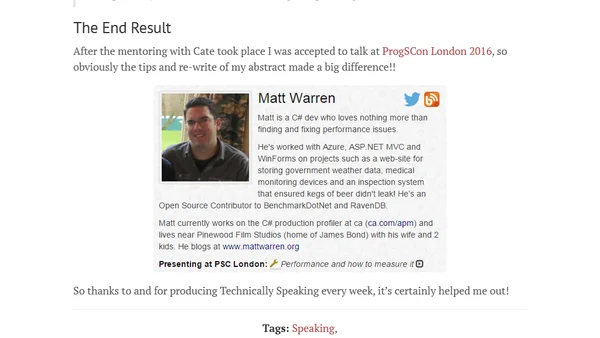
A developer shares their experience in a tech speaking mentorship program, learning how to craft compelling talk abstracts and improve CFP submissions.
Matt Warren is a software developer and writer focused on deep technical analysis of the .NET runtime, C# internals, performance, and low-level runtime behavior.
76 articles from this blog
A developer shares their experience in a tech speaking mentorship program, learning how to craft compelling talk abstracts and improve CFP submissions.
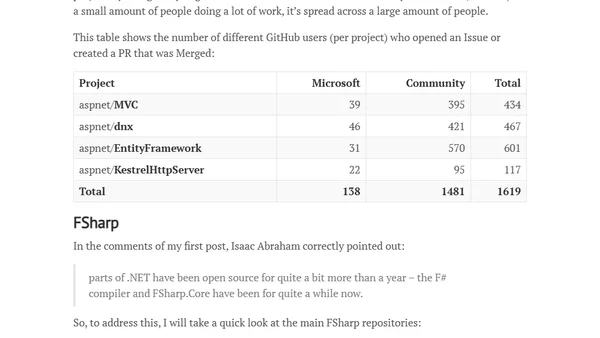
An in-depth exploration of how the .NET Garbage Collector works internally, focusing on its low-level mechanisms and design goals.
Analyzes community contributions to open-source ASP.NET projects (MVC, DNX, Entity Framework, Kestrel) one year after Microsoft's .NET open-sourcing.
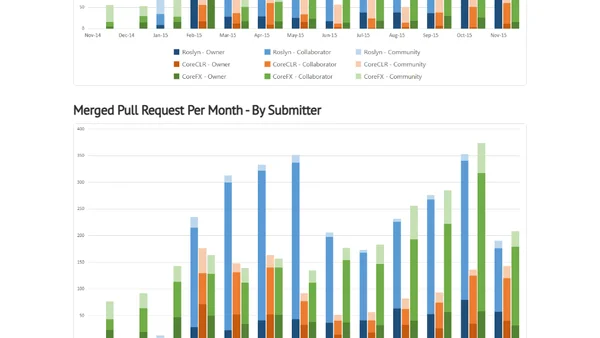
Analyzes community involvement in open-source .NET projects (Roslyn, CoreCLR, CoreFX) one year after Microsoft's announcement, using GitHub data.
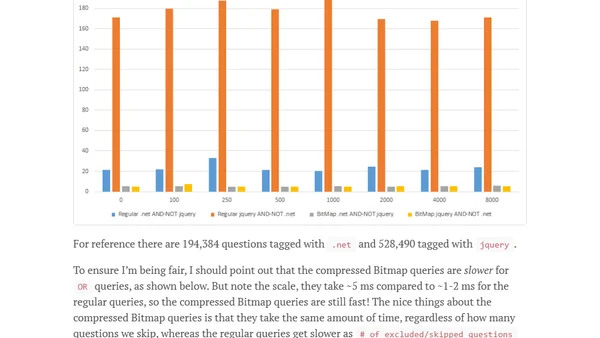
Part 3 of a series on building Stack Overflow's tag engine, focusing on implementing complex boolean queries using bitmap indexes and compression.
Deep dive into the technical design of Stack Overflow's Tag Engine, focusing on implementing ignored tag preferences and performance considerations.
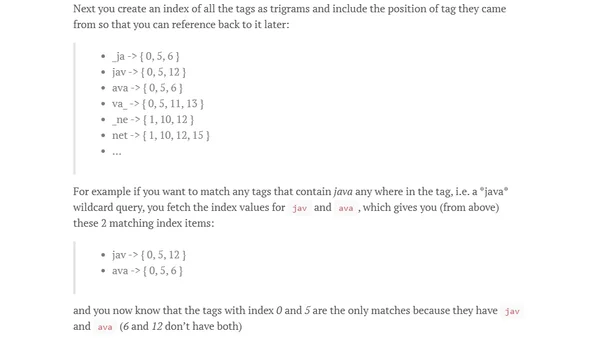
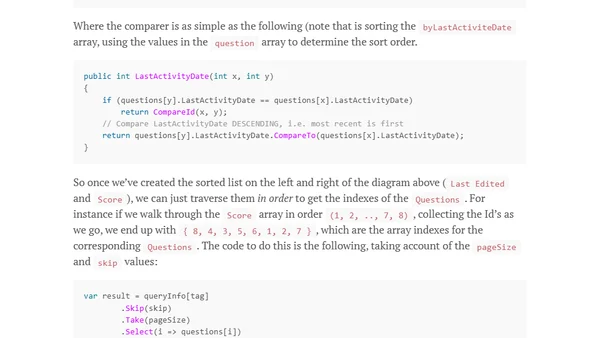
A technical deep-dive into building a tag engine similar to Stack Overflow's, covering data processing, memory usage, and performance.
A guide to the challenges and best practices of micro and nano-benchmarking in software development, using .NET examples.
Part 2 of performance lessons from Stack Overflow, focusing on .NET Garbage Collector optimization and high-performance JSON serialization with Jil.
Analyzes Stack Overflow's performance-first engineering culture, including trade-offs like skipping unit tests for speed and building custom servers over cloud hosting.
Explains how commercial mocking tools like Typemock and JustMock mock sealed classes and static methods using the .NET Profiling API.
Explains how HdrHistogram's .NET port controls class field layout to minimize overhead for low-latency performance measurement.
An update on measuring .NET GC performance, correcting methodology and interpreting results with expert feedback.
Analyzes the impact of the .NET Garbage Collector on application latency, explores GC pause detection, and discusses mitigation strategies.
Explores performance optimization techniques from the Roslyn compiler codebase, focusing on minimizing garbage collector work through allocation avoidance and object pooling.
Analyzes performance lessons from the Roslyn compiler codebase, focusing on how Microsoft measures and ensures compiler speed.