Gnocchi 4.1 is out
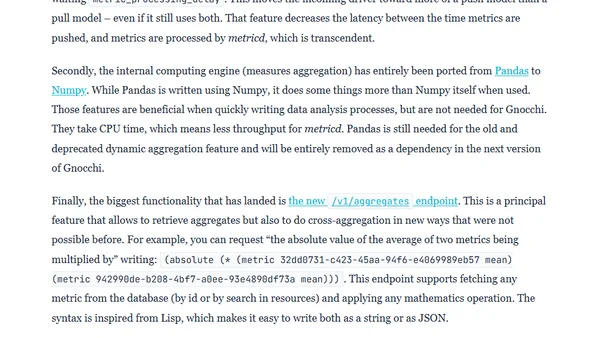
Gnocchi 4.1 release notes highlight new Redis notification support, a Pandas to Numpy migration, and a powerful new aggregates API.
Julien Danjou est un vétéran de l'open source avec 25 ans d'expérience, CEO et co-fondateur de Mergify, et créateur du gestionnaire de fenêtres awesome. Découvrez les insights du plus jeune développeur Debian en 2002, leader du projet de télémétrie OpenStack et créateur de la base de données de séries temporelles Gnocchi. Explorez l'expertise issue des innovations cloud computing chez Red Hat, du développement du profileur Python chez Datadog et de la maîtrise des mécanismes internes de CPython. Apprenez de l'auteur des livres "Serious Python" et "Scaling Python", animateur du podcast français CI/CD "Nom d'un Pipeline!" et fondateur du Toulouse SaaS Club. Suivez pour des insights sur les plateformes SaaS, l'expertise en développement Python, les meilleures pratiques CI/CD, l'optimisation de l'expérience développeur, les contributions GNU Emacs et la programmation Lisp. Accédez aux connaissances sur l'automatisation de fusion de code, la collaboration d'équipes d'ingénierie logicielle et l'architecture cloud computing.
246 articles from this blog
Gnocchi 4.1 release notes highlight new Redis notification support, a Pandas to Numpy migration, and a powerful new aggregates API.
An interview with open source developer Julien Danjou about his programming career, work on Python and Gnocchi, and his book.
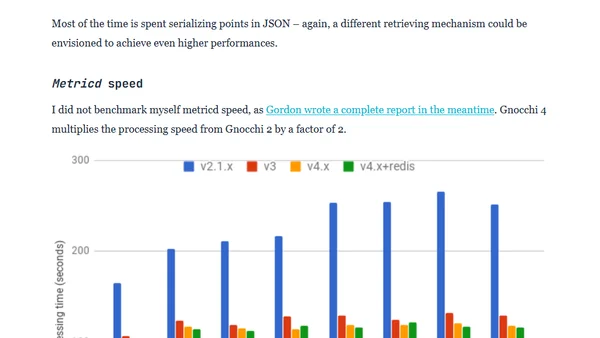
Performance benchmark of Gnocchi 4.0, a time-series database, comparing its speed and new Redis driver to version 2.0.
Author discusses attending PyCon FR 2017 to give a talk on scalable Python applications and lead a development sprint for the Gnocchi project.
A technical comparison of two open-source time series databases, Gnocchi and Prometheus, focusing on their features, architectures, and use cases.
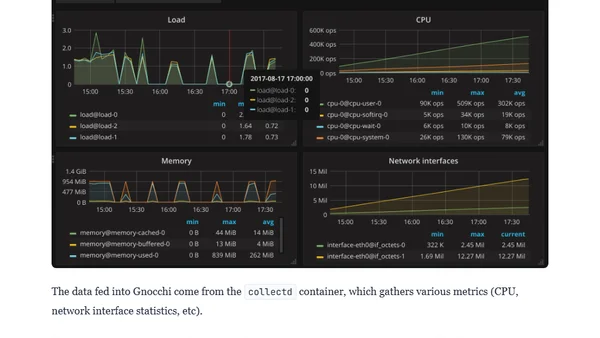
A guide on deploying and using the Gnocchi metrics storage system with Docker, Docker Compose, Grafana, and collectd.
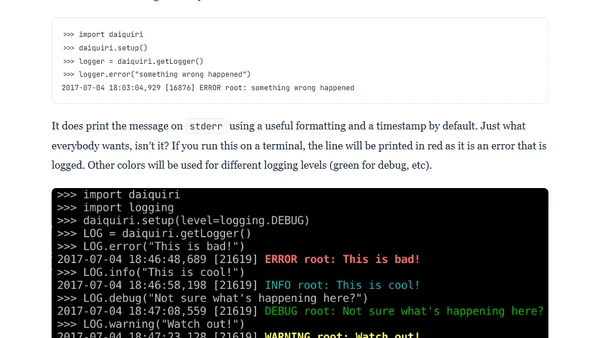
Introduces daiquiri, a Python library that simplifies logging setup with sensible defaults like timestamps, colors, and JSON output.
Gnocchi 4.0, a major release of the time series database, introduces performance improvements, a Redis driver, and a rewritten scheduling mechanism.
Introducing git-pull-request, a command-line tool to automate creating and updating GitHub pull requests directly from your shell.
A developer's recap of the 2017 OpenStack Summit in Boston, discussing event changes, community dispersion, and project impacts.
The Gnocchi project announces its decision to leave the OpenStack ecosystem to gain independence and improve development pace and contributor accessibility.
Introducing the tenacity library, a Python fork of retrying for robust error handling with flexible retry logic and backoff strategies.
A tutorial on configuring and using Gnocchi's new S3 driver to store metrics on Amazon Web Services (AWS).
A tutorial on configuring collectd to send system metrics to the Gnocchi time-series database for monitoring and visualization.
A developer's recap of presenting the Gnocchi time-series database at the FOSDEM 2017 open-source conference in the Python devroom.
Gnocchi 3.1 release notes highlight major new features including modularized REST API auth, performance improvements, and new storage architecture.
Explains how to use pbr (Python Build Reasonableness) to simplify Python packaging with setup.cfg and automate tasks like dependency management.
A developer's experience and technical takeaways from the OpenStack Summit Ocata, covering contributions, Python 3, and project updates.
A software engineer shares insights on managing a small, remote, agile team focused on open-source development, emphasizing team size, communication, and culture.
Announcing Gnocchi 3.0, a major release of the time-series database featuring a new high-performance storage engine and LZ4 compression.