Getting a big scientific prize for open-source software
Authors of scikit-learn receive a major scientific prize, highlighting a cultural shift towards recognizing open-source software as valuable academic contribution.
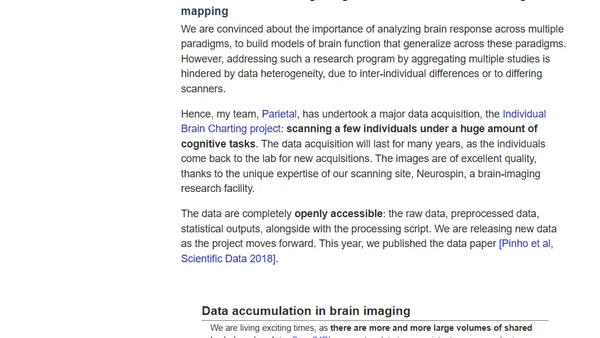
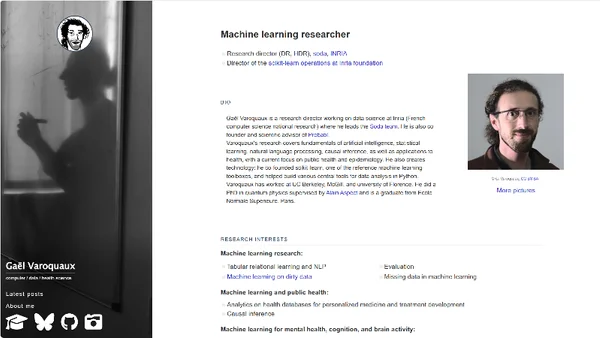
Alex presents the work and impact of Gaël Varoquaux, a leading AI researcher at Inria, co-founder of scikit-learn, and expert in machine learning, data science, and public health.
81 articles from this blog
Authors of scikit-learn receive a major scientific prize, highlighting a cultural shift towards recognizing open-source software as valuable academic contribution.
A researcher's 2018 highlights: using machine learning for cognitive brain mapping, analyzing non-curated data, and contributing to scikit-learn development.
Inria establishes a foundation to secure funding and support for the scikit-learn open-source machine learning library, enabling sustainable growth and development.
A report on recent scikit-learn sprints in Austin and Paris, highlighting new features, bug fixes, and progress toward the 0.20 release.
Argues that scientific progress requires reusable software libraries, not just reproducible results, and discusses challenges in computational research.
A summary of the 2017 Paris sprint for scikit-learn, highlighting participants, achievements, and support for the open-source machine learning library.
A researcher's 2016 highlights: AI mapping to human vision, brain-based autism prediction, and fast matrix factorization algorithms for neuroimaging.
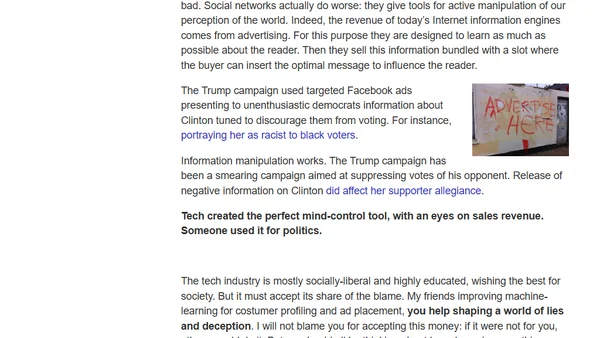
A data scientist argues that data science and targeted advertising on social media have distorted reality and influenced major political events like Brexit and the US election.
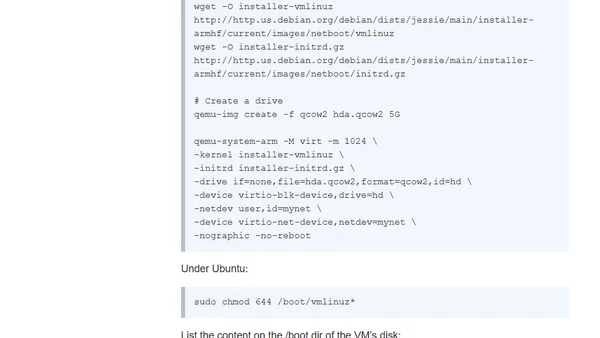
A developer shares statically compiled Unison 2.48 binaries for ARM architecture, along with detailed build notes using QEMU and Debian.
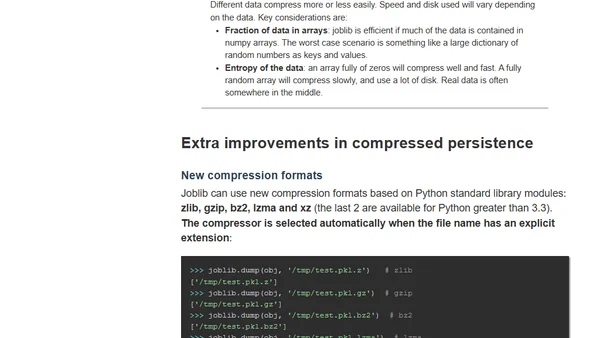
Explains improvements in joblib's compressed persistence for Python, focusing on reduced memory usage and single-file storage for large numpy arrays.
Explores the importance of reproducible science in computer science, focusing on reproducibility, replicability, and reusability of software and data.
Nilearn 0.2 release enhances machine learning for neuroimaging with new spatial regularizations, dictionary learning, and improved visualization tools.
A post-doc position in computational neuroscience using Python and machine learning to find biomarkers from fMRI brain connectivity data.
Summary of the 2015 MLOSS workshop on open-source machine learning software, covering key talks and the maturing community.
A summary of the second Nilearn sprint, highlighting new features and improvements for this neuroimaging machine learning library.
Discusses the tension between reproducibility in scientific software and practical software engineering, advocating for progressive code consolidation over unrealistic release standards.
Announcing the MLOSS workshop at ICML 2015, focusing on open-source software and ecosystems for machine learning.
Announcing EuroSciPy 2015, the European conference on Python for scientific computing, with calls for papers, talks, and tutorials.
A developer details migrating their personal website from WordPress to a static site using Pelican, Pure CSS, and Disqus for simplicity and security.
A curated list of resources and tutorials for improving Python programming style, covering basics to advanced topics like design patterns and functional programming.