Combinatorial coordinates for the aperiodic Spectre tiling
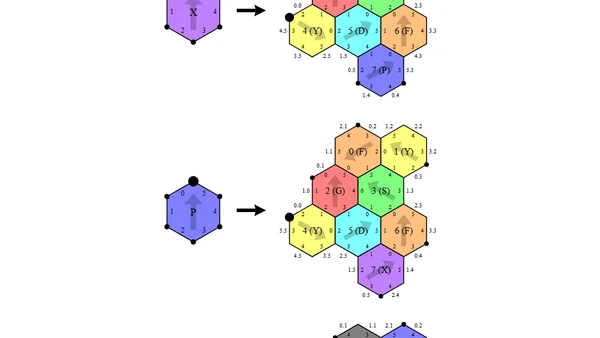
A technical article explaining a combinatorial coordinate system for generating the aperiodic Spectre tiling, a recent mathematical discovery.
Explores the potential and implications of using AI to automate mathematical theorem proving, framing it as a 'tame' problem solvable by machines.
Explores combinatory logic using bird metaphors, connecting the S and K combinators to lambda calculus and programming concepts.
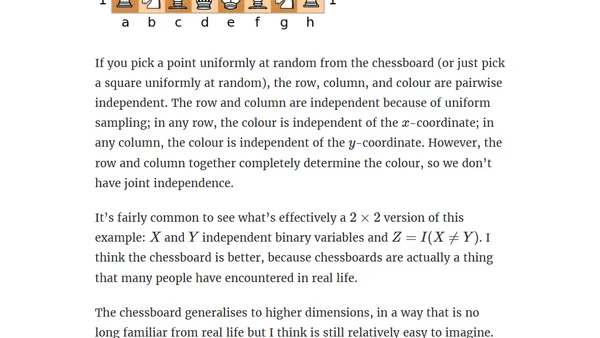
Explains why pairwise independence of variables does not imply joint independence, using a chessboard as an intuitive counterexample.
Explores convolutions in probability theory, explaining how they combine distributions and compute sums of random variables.
A mathematical and computational exploration of the probability of a coin landing on its edge, inspired by Matt Parker's question about a 'three-sided coin'.
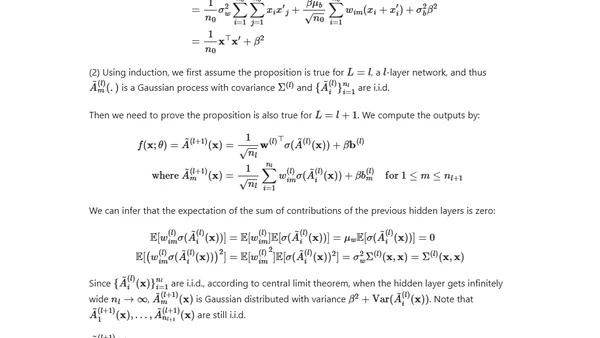
A deep dive into the Neural Tangent Kernel (NTK) theory, explaining the math behind why wide neural networks converge during gradient descent training.
A mathematical critique of additive scoring in grading and grant reviews, arguing for non-additive monotone functions.
A mathematical analysis of why a garden sprinkler waters unevenly, deriving equations for water distribution and proposing a technical fix.
Introduces linear algebra concepts like vector spaces and orthogonality as a foundation for understanding generalized Fourier series expansions.
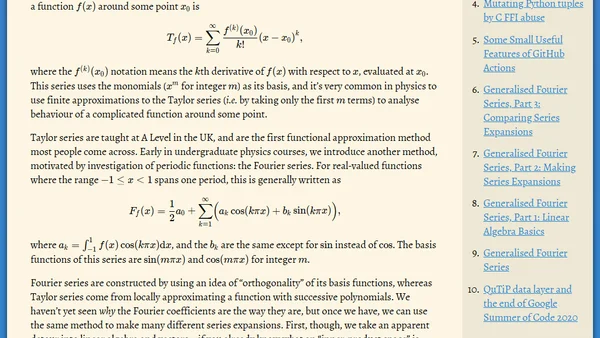
Explores generalized Fourier series expansions using orthogonal function bases, with examples from Legendre polynomials and practical Jupyter notebook code.
The article critiques modern education for focusing on rote memorization of formulas over intuitive understanding, using examples from math and science.
A statistician argues that advanced math like calculus isn't a strict prerequisite for learning statistics, using personal experience and examples.
Analyzing a classic probability problem involving dice rolls, its historical context with Newton and Pepys, and the mathematical intuition behind it.
An introductory explanation of permutation patterns, covering basic permutations, slot restrictions, and their relevance to programming and mathematics.
Explores the mathematical design of the game Spot It! using finite projective planes and prime numbers, with code on GitHub.
A programmer analyzes whether math classes are useful in a software development career, based on personal experience.
Explains the mathematical relationship between the tanh and logistic sigmoid functions, and why tanh is preferred in neural networks.
Explores non-transitivity in games like rock-paper-scissors, its history, and connections to statistics, evolution, and voting systems.
Argues that true data science and innovation require deep mathematical understanding, not just push-button tools, and defends the value of skilled data scientists.