Holonomic functions
Explores holonomic functions, which solve linear differential equations with polynomial coefficients, and their prevalence among special functions in Abramowitz and Stegun.
Explains why second order linear differential equations with polynomial coefficients are important in physics and applications, linking to separable PDEs.
Explores the surprising link between counting unlabeled rooted trees and designing Runge-Kutta methods for differential equations.
Explains why Runge-Kutta methods need more stages than order for p≥5, known as the Butcher barrier, with examples like Dormand-Prince.
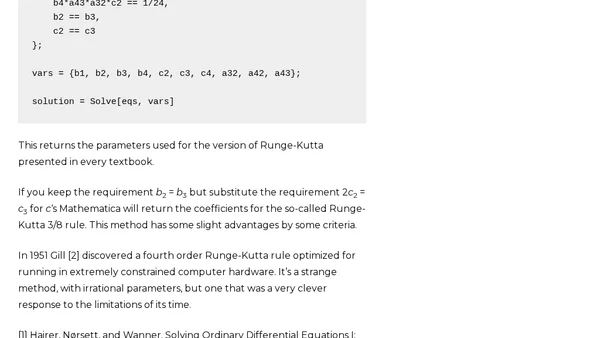
Exploring the derivation of Runge-Kutta method coefficients by solving the RK4 design equations using Mathematica, including variations like the 3/8 rule and Gill's method.
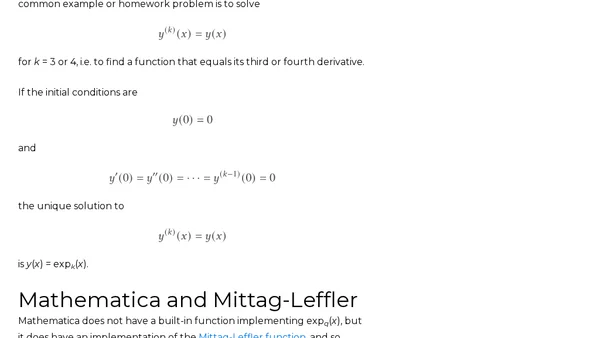
Explores the function expq(x), its closed forms, differential equations, and relation to the Mittag-Leffler function.
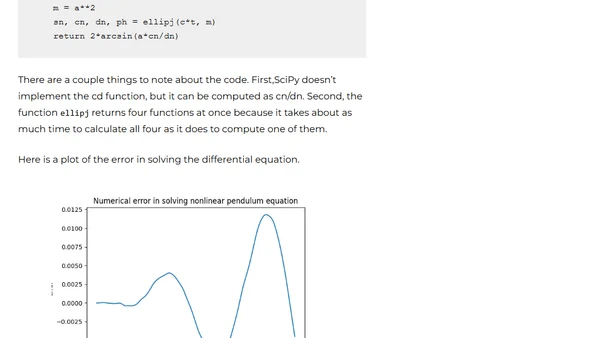
Explores the exact closed-form solution to the nonlinear pendulum equation using Jacobi elliptic functions, comparing it with numerical and linearized solutions.
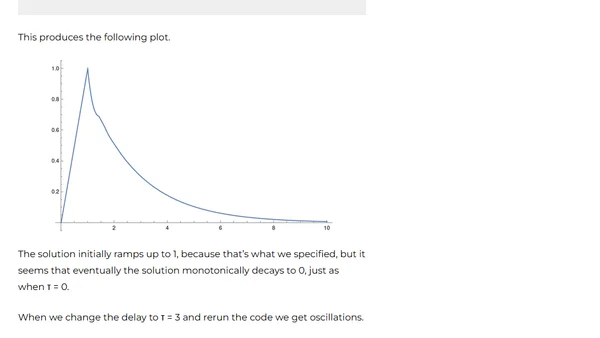
Explores how small delays affect differential equations, comparing behavior with and without delays using mathematical analysis and examples.
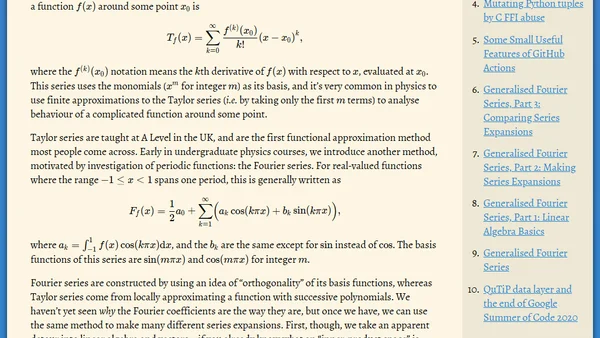
Explores generalized Fourier series expansions using orthogonal function bases, with examples from Legendre polynomials and practical Jupyter notebook code.
A mathematical model of traffic flow explaining phantom traffic jams using car-following equations.
Explores the damped and driven oscillator using a pendulum, focusing on phase space analysis and differential equations in Matlab.