The Pragmatic Programmer revisited
A review of 'The Pragmatic Programmer' book, assessing its timeless principles and relevance in modern software development.
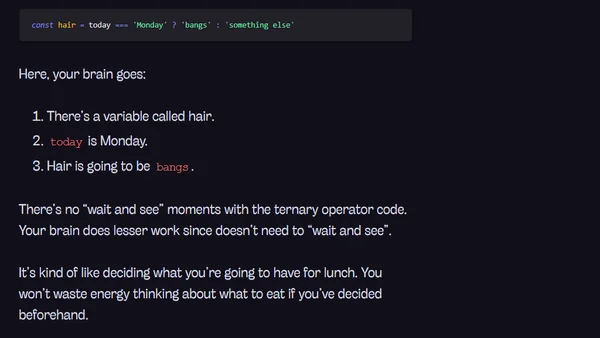
A critique of 'cute coding' practices that sacrifice code readability and maintainability for clever, terse syntax.
Explores the mindset shift from writing code to designing systems, focusing on user impact and strategic technology choices.
A rebuttal to common misconceptions and suboptimal practices in Java Streams, using a specific article as a starting point.
Explores best practices for writing clean, small, and maintainable functions in JavaScript to improve code quality and reduce complexity.
Explores why 'else' expressions are considered unnecessary in programming, offering alternative patterns like early returns and the State Pattern.
A guide to modernizing JavaScript code by replacing old ES5 patterns with cleaner ES2015+ features like template literals.
A guide to modernizing JavaScript code by replacing ES5 hacks and workarounds with cleaner, native ES2015+ alternatives.
Analyzes the time investment and value of code comments, covering initial writing and maintenance costs versus long-term benefits.
A developer argues against committing commented-out code, explaining why it harms code readability and maintainability.
A detailed categorization of code comments, exploring their types, maintenance, location, and alternatives to improve code clarity.
Explains the importance of making class dependencies explicit in software design to reduce surprises and improve code maintainability.
Applies the 'keep your bench clean' principle from cooking to software development, emphasizing clean code, atomic commits, and removing unused code.
A developer argues for the importance of clean, high-quality code comments and clarifies their relationship to documentation.
Discusses the tension between reproducibility in scientific software and practical software engineering, advocating for progressive code consolidation over unrealistic release standards.
Explores how C# 6.0 features, like the nameof operator, help developers write safer, less error-prone code by preventing common mistakes.
Explains four key programming principles (KISS, DRY, YAGNI, SOLID) for building sustainable and maintainable mission-critical software applications.
A tutorial on using Gulp.js, a Node.js task runner, to automate code quality checks like PHP linting and unit testing in development projects.
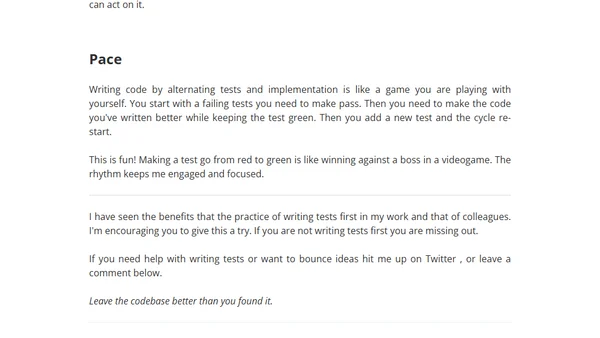
Five practical habits to improve your software development skills, including planning, atomic commits, and writing tests.
Discusses the misuse of guard clauses in code, arguing for domain-specific exceptions over generic null checks.