A simple filtering syntax tree in Python
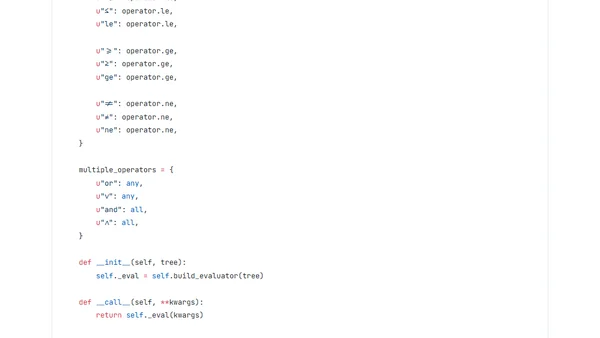
A guide to building a simple syntax tree in Python for creating a Domain-Specific Language (DSL) to filter data based on user-defined conditions.
Julien Danjou est un vétéran de l'open source avec 25 ans d'expérience, CEO et co-fondateur de Mergify, et créateur du gestionnaire de fenêtres awesome. Découvrez les insights du plus jeune développeur Debian en 2002, leader du projet de télémétrie OpenStack et créateur de la base de données de séries temporelles Gnocchi. Explorez l'expertise issue des innovations cloud computing chez Red Hat, du développement du profileur Python chez Datadog et de la maîtrise des mécanismes internes de CPython. Apprenez de l'auteur des livres "Serious Python" et "Scaling Python", animateur du podcast français CI/CD "Nom d'un Pipeline!" et fondateur du Toulouse SaaS Club. Suivez pour des insights sur les plateformes SaaS, l'expertise en développement Python, les meilleures pratiques CI/CD, l'optimisation de l'expérience développeur, les contributions GNU Emacs et la programmation Lisp. Accédez aux connaissances sur l'automatisation de fusion de code, la collaboration d'équipes d'ingénierie logicielle et l'architecture cloud computing.
239 articles from this blog
A guide to building a simple syntax tree in Python for creating a Domain-Specific Language (DSL) to filter data based on user-defined conditions.
Fixing WSGI URL scheme issues when using Cloudflare's Flexible SSL mode, with a custom middleware solution.
A retrospective on the OpenStack Telemetry project's evolution, covering technical debt, project splitting, and challenges with community adoption.
A developer reflects on the early challenges and design decisions during the incubation of Ceilometer, the OpenStack Telemetry project.
A developer's analysis of Python's suitability for large-scale enterprise projects, addressing performance concerns and comparing it to Java and Go.
Analysis and optimization of the Gnocchi time-series database engine, focusing on reducing I/O operations to improve performance.
A developer reflects on migrating their personal blog from a custom static site to the Ghost platform, discussing the evolution of web tech and maintenance trade-offs.
Explores scaling a Python polling application using tooz for distributed task coordination across multiple machines.
A technical guide on scaling a Python SSH polling application using asyncio and AsyncSSH to handle thousands of concurrent connections efficiently.
Gnocchi 4.2 release introduces new InfluxDB/Prometheus compatibility endpoints, ACL improvements, and performance enhancements for the time series database.
Explores scaling a Python polling app using parallelism to manage thousands of SSH/ping connections efficiently, focusing on concurrent.futures.
Introducing Pastamaker, a tool to automate a safe GitHub pull-request workflow with required reviews and up-to-date CI testing.
Introduces Python experts featured in the book 'Scaling Python', covering topics like distributed systems, performance, and APIs.
Gnocchi 4.1 release notes highlight new Redis notification support, a Pandas to Numpy migration, and a powerful new aggregates API.
An interview with open source developer Julien Danjou about his programming career, work on Python and Gnocchi, and his book.
Performance benchmark of Gnocchi 4.0, a time-series database, comparing its speed and new Redis driver to version 2.0.
Author discusses attending PyCon FR 2017 to give a talk on scalable Python applications and lead a development sprint for the Gnocchi project.
A technical comparison of two open-source time series databases, Gnocchi and Prometheus, focusing on their features, architectures, and use cases.
A guide on deploying and using the Gnocchi metrics storage system with Docker, Docker Compose, Grafana, and collectd.
Introduces daiquiri, a Python library that simplifies logging setup with sensible defaults like timestamps, colors, and JSON output.