AI Only Has to Beat 3/10
Argues that AI doesn't need to be perfect to disrupt business and cybersecurity, as most current systems are mediocre (3/10) and AI at 5/10 can still dominate.
Daniel Miessler is a cybersecurity and AI engineer turned founder, based in the San Francisco Bay Area. He shares insights on cybersecurity, artificial intelligence, technology, and human behavior through essays, tutorials, and technical content on his blog.
164 articles from this blog
Argues that AI doesn't need to be perfect to disrupt business and cybersecurity, as most current systems are mediocre (3/10) and AI at 5/10 can still dominate.
Analysis of Mythos AI's impact on knowledge work, arguing its cybersecurity prowess signals a broader disruption to all white-collar jobs.
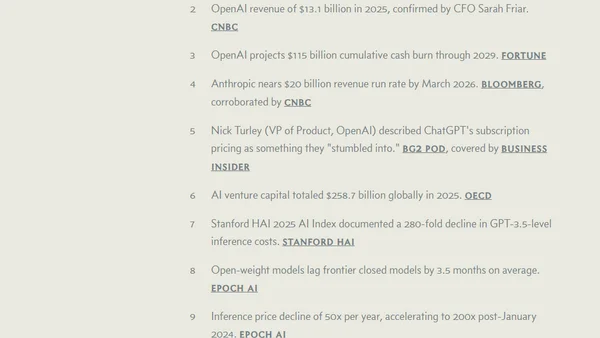
Analysis of rising AI inference costs and the need for multi-model strategies to manage expenses.
How autonomous AI pipelines can compress decades of cross-domain knowledge transfer into days, with 23 verified historical examples.
Explores key AI ideas like autonomous component improvement, intent-based engineering, and transparency shaping the future of technology.
Analysis of AI inference costs ending subsidies, predicting a split between expensive frontier models and cheap open-source alternatives.
Explores the confusion between Soft AGI (emulating human replacement) and Hard AGI (true human-level learning generality).
AI reveals most knowledge work is scaffolding overhead, not core tasks, making it easy to automate.
Argues that AI will replace knowledge work, challenging the narrative that humans are irreplaceable, and explains why this is beneficial.
Argues for using general SOTA AI models over custom, specialized ones, predicting cheaper, open-source general models will dominate.
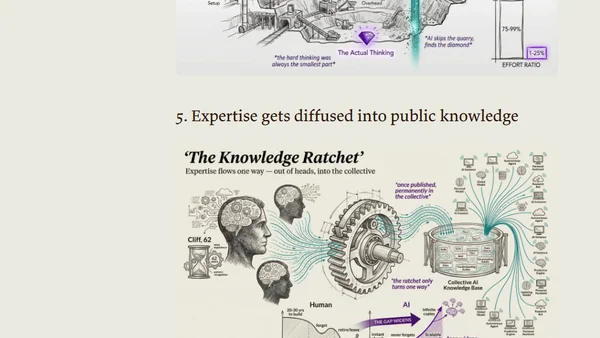
Explores the 'Great Transition' where AI, especially LLMs and skills, is making specialized knowledge public, reshaping knowledge work and expertise.
Explores Bitter Lesson Engineering, advocating for AI systems that discover solutions autonomously rather than relying on human-coded logic.
A guide to customizing the spinner text in Claude Code AI with personal, meaningful verbs from books, movies, and life.
A speculative blog post predicting that a universal 'Last Algorithm' for AI problem-solving could emerge in 2026 through advanced iterative loops.
The article argues that the perceived addiction to AI coding tools like Claude Code is actually an addiction to the empowering feeling of creation and rapid application development.
A retrospective analysis of AI predictions made since 2016, examining what was right, wrong, and still unfolding in the field of artificial intelligence.
A look at key AI trends for 2026, focusing on verifiability, continuous agents, and vertical problem-solving.
Predicts AI-driven shifts in cybersecurity for 2026, focusing on agentic platforms, secure coding, and automated asset management.
How AI is enabling individuals to build custom software for personal use, replacing paid apps and unlocking new creative potential.
A 9-tier framework for measuring personal AI progress, from basic chatbots to advanced AI companions with deep context and autonomy.