Swift 4 Upgrade Error: ‘init(colorLiteralRed:green:blue:alpha:)’ is unavailable
Fix for Swift 4 error: 'init(colorLiteralRed:green:blue:alpha:)' unavailable, use UIColor(red:green:blue:alpha:) instead.

Andrew Bancroft — Experienced iOS developer, educator, and writer with 15+ years of experience, sharing clear, practical guidance on Swift, SwiftUI, iOS development, and data persistence to help developers succeed.
204 articles from this blog
Fix for Swift 4 error: 'init(colorLiteralRed:green:blue:alpha:)' unavailable, use UIColor(red:green:blue:alpha:) instead.

Guide to finding the SQL Server 2017 Reporting Services license key from the main installer.
Explores six types of data analysis: descriptive, exploratory, inferential, predictive, causal, and mechanistic, with a decision framework.
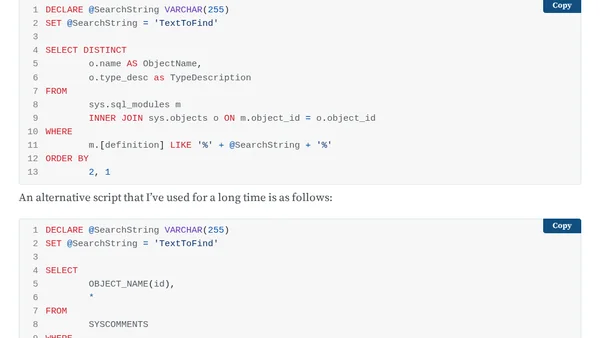
A script to search text within SQL database object definitions like functions, procedures, and views.
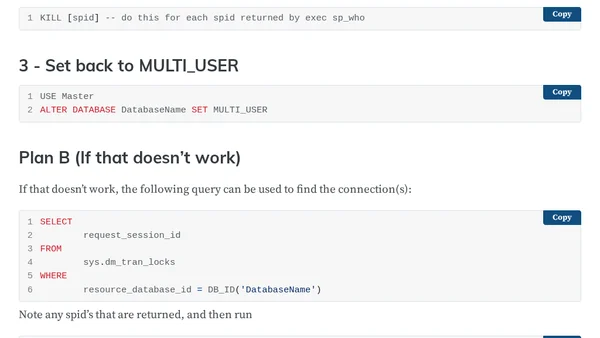
Steps to exit SINGLE_USER mode in SQL Server by killing connections and switching back to MULTI_USER.
Explains dimensional models in data, breaking down the concepts of measurements, descriptions, and how models represent data for analysis.
A guide to 10 high-level stages for completing a machine learning task, from defining business metrics to data transformation.
Learn to identify predictive analytics questions using patterns and keywords like 'which', 'will', and 'likely'.
A simple explanation of what data is, using a bug hunt analogy to make it understandable for a 5-year-old.
A comprehensive guide to local receipt validation for iOS in Swift, with seven tutorials and a GitHub repository.
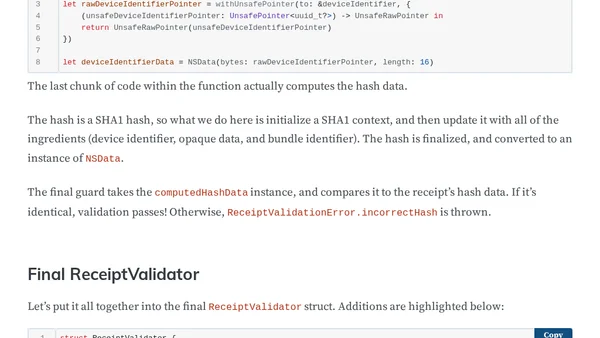
Guide to finalizing receipt validation in Swift by computing and comparing the GUID hash for your app.
A guide to parsing and decoding Apple receipts in Swift, extracting metadata for validation.
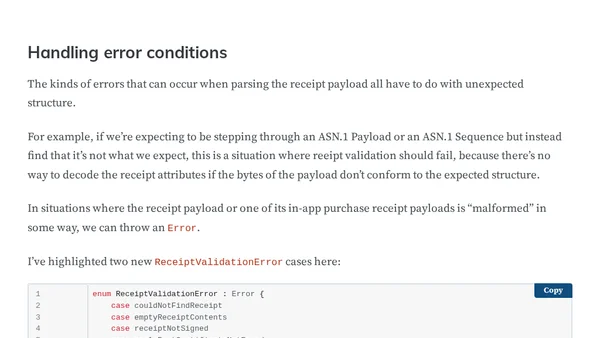
Guide on verifying receipt signatures in Swift using PKCS #7 containers and Apple's root certificate.
Guide on configuring NSPersistentContainer to use an existing SQLite store in Core Data.
Explores the origin of the term 'closure' in Swift, using synonyms and a swimming pool analogy to explain variable capturing.
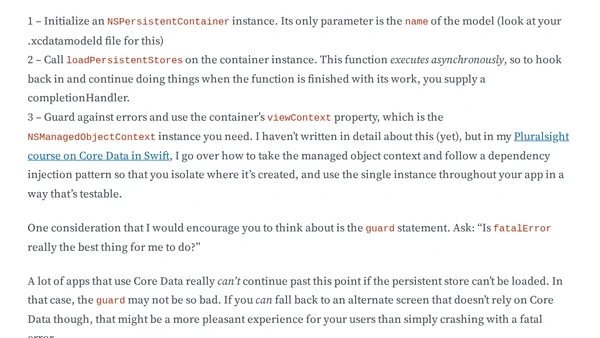
A Swift tutorial on implementing the Core Data stack using NSPersistentContainer for iOS 10+.
Explains why Swift requires @escaping annotation for escaping closures, based on compiler design and developer safety.
Explains escaping closures in Swift: definition, scenarios like storing closures as state or async callbacks, and why developers must mark them with @escaping.
Explores how every developer is an API designer, emphasizing mindful creation of interfaces in code.
Explains why Core Data model attribute types must match NSManagedObject property types to avoid runtime crashes.