Avoiding ToString() allocations with StringBuilder.MoveChunks: Exploring the .NET 11 preview - Part 3
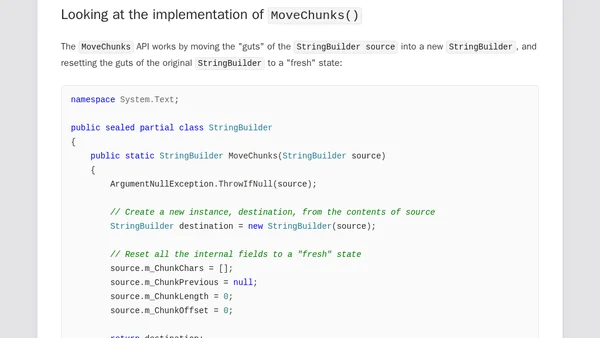
Explores the new StringBuilder.MoveChunks() API in .NET 11 preview, its usage, implementation, and performance benefits for reducing allocations.

Explores Go's new Green Tea garbage collector in 1.26, comparing it with the old collector and C# memory management.
Learn how to reduce byte[] allocations in .NET Framework using ReadOnlySpan<T> for better performance.
Analysis of jemalloc usage in major projects after its archival and Meta's takeover, with a survey of who still uses it in 2026.
A technical guide exploring advanced linked list techniques in C, including memory allocation, traversal, and performance optimization.
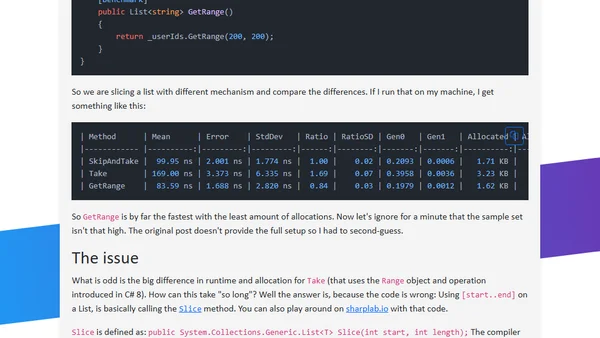
Analyzes C# performance benchmarks for slicing lists, comparing Skip/Take, Range operator, and GetRange methods, highlighting a common benchmarking error.
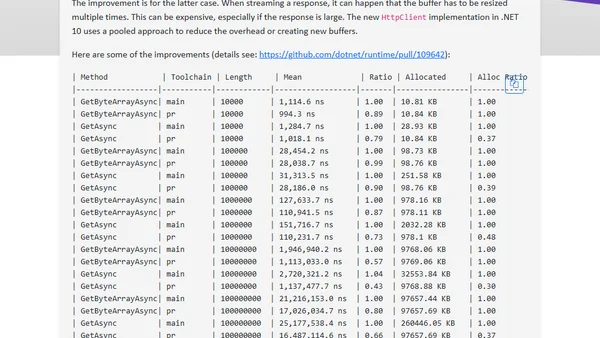
Explores performance improvements in .NET 10's HttpClient, focusing on reduced memory allocation and faster response times for streaming data.
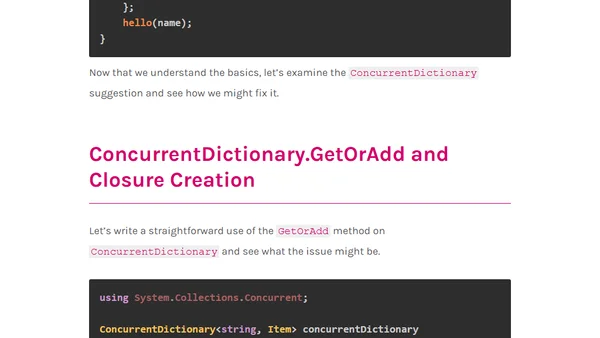
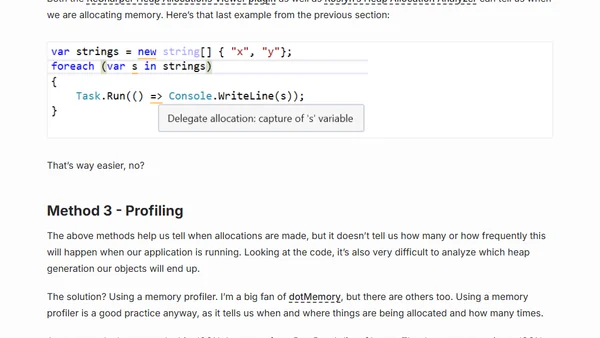
Explains how to avoid unnecessary closure allocations when using ConcurrentDictionary.GetOrAdd in C# for better performance and concurrency.
Explains how to improve C# performance by using AsSpan instead of Substring to reduce memory allocations and overhead.
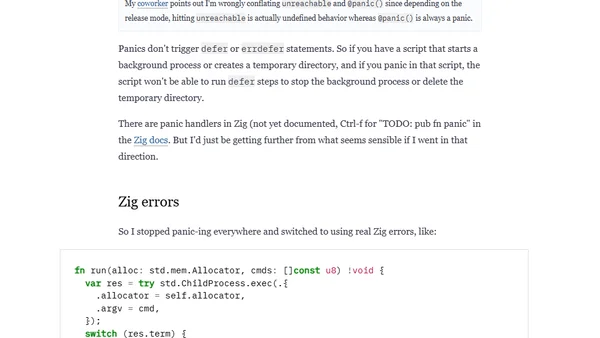
A developer's personal experience and insights on error handling in Zig, focusing on memory allocation failures and the 'try' keyword.
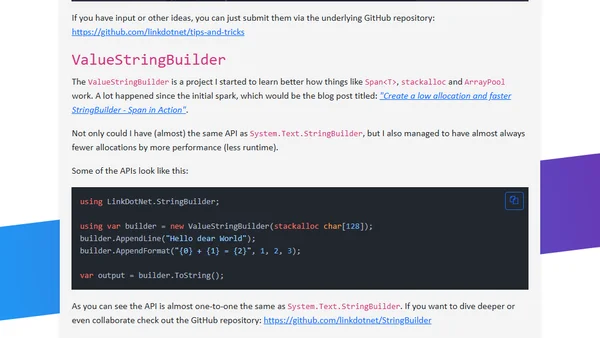
Introduces a .NET tips and tricks website and a high-performance ValueStringBuilder project, showcasing low-allocation string building techniques.
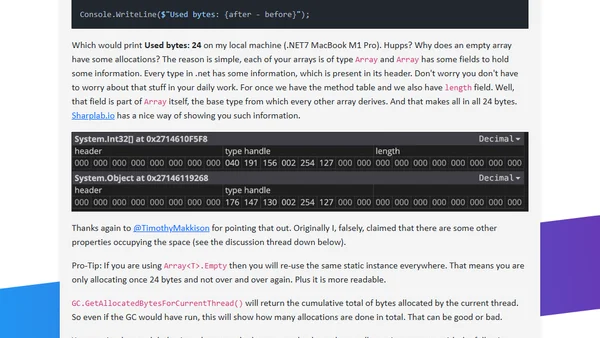
Explains how to measure heap allocations in .NET and reveals that an empty array consumes 24 bytes due to object overhead.
A guide to creating a low-allocation, faster StringBuilder alternative in C# using Span<T> for improved performance in string concatenation.
Explains a surprising heap allocation in a Go benchmark when sorting strings, diving into interface internals and compiler behavior.
Explains virtual memory, MMU, page tables, and how processes use memory mapping and swap space.
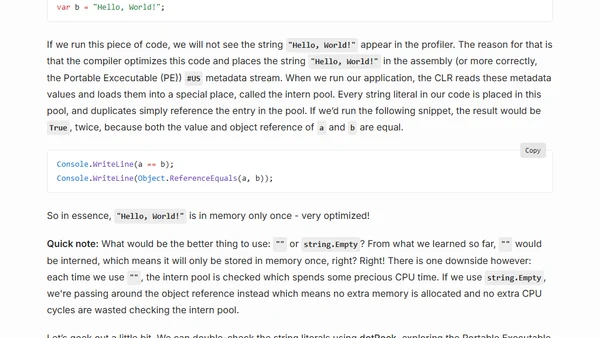
Explains how strings in .NET are objects subject to garbage collection, analyzing their memory allocation and behavior.
Explains how the .NET Garbage Collector works and provides techniques to reduce memory allocations for faster applications.
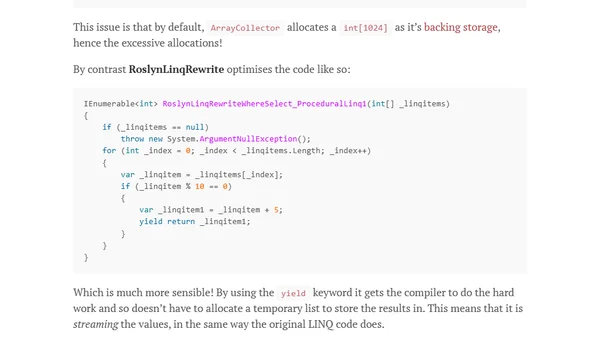
Analyzes performance inefficiencies in LINQ queries, including hidden allocations, and offers optimization techniques for C# developers.
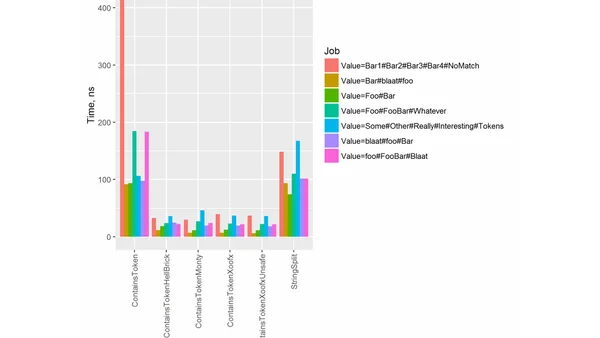
Explores benchmarking tools and techniques using a Stack Overflow code example, focusing on performance optimization and avoiding allocations.
A deep dive into using BenchmarkDotNet to analyze memory allocations and performance differences between string concatenation and StringBuilder in C#.