Is Nokia Doomed?
Analyzes Nokia's future in 2010, debating its high-end product struggles, Symbian's decline, and differing US/European market perspectives on data plans and phone usage.
Theodore Ts’o — Linux kernel developer and technologist writing about Linux, filesystems, open source, and the broader impact of technology on society.
51 articles from this blog
Analyzes Nokia's future in 2010, debating its high-end product struggles, Symbian's decline, and differing US/European market perspectives on data plans and phone usage.
Android Gingerbread will adopt the ext4 filesystem for improved performance, especially on dual-core ARM devices, replacing YAFFS.
Explores how the nature of technology work at startups has evolved, contrasting traditional hardware-focused ventures with modern software startups leveraging open source.
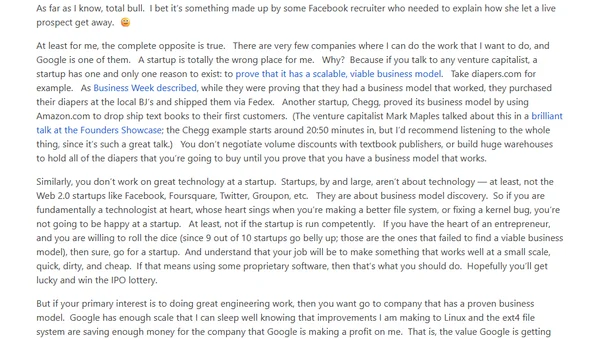
A Google engineer refutes claims about talent retention, arguing that Google is ideal for technologists focused on deep engineering work, unlike startups focused on business models.
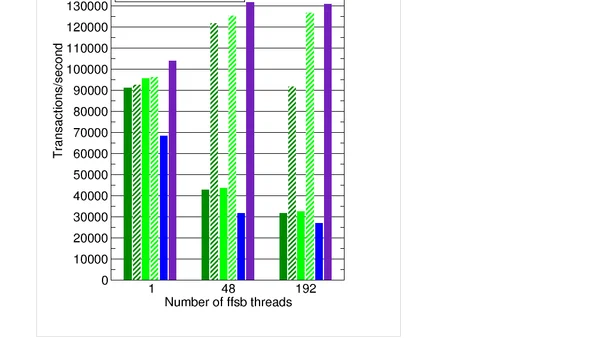
A developer presents benchmark results showing ext4 filesystem scalability improvements on a 48-core system for an upcoming Linux kernel talk.
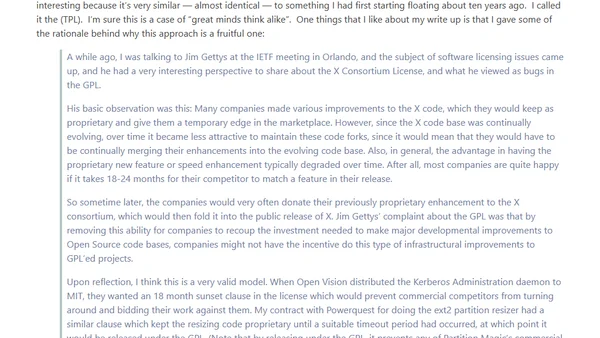
Explores the Transitive Grace Period Public Licence, a software license allowing temporary proprietary use of improvements before open-sourcing.
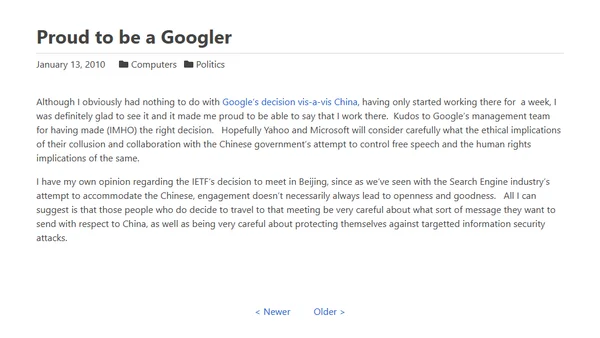
A new Googler expresses pride in the company's ethical stance against censorship in China and discusses tech industry implications.
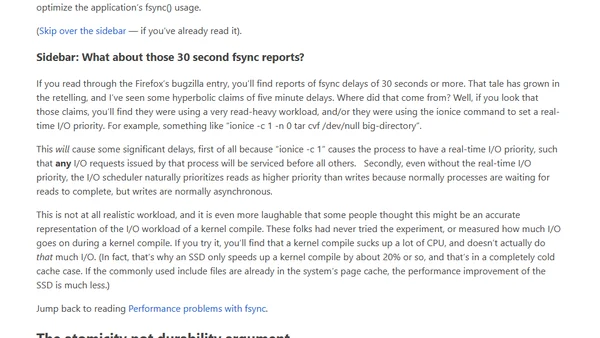
Debunks common myths about the fsync() system call in Linux, explaining its importance for data durability and addressing performance concerns.
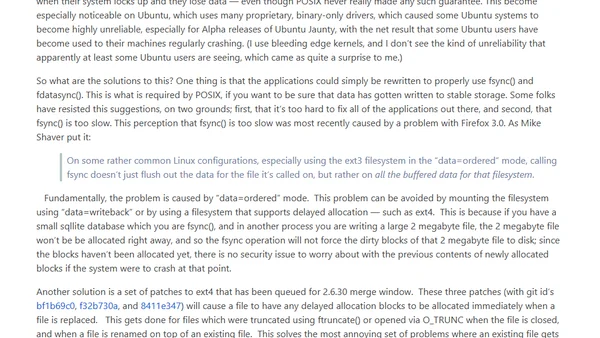
Explains the ext4 delayed allocation feature and the data loss risks for applications not using fsync(), addressing a recent Ubuntu bug.
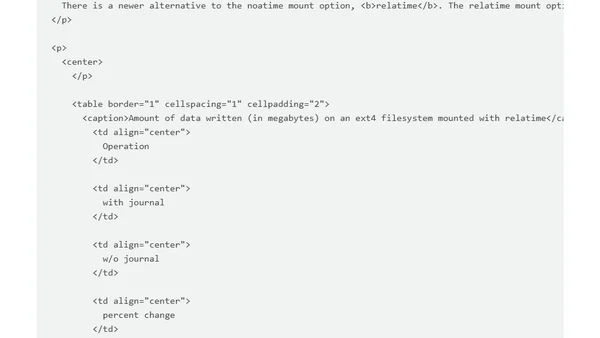
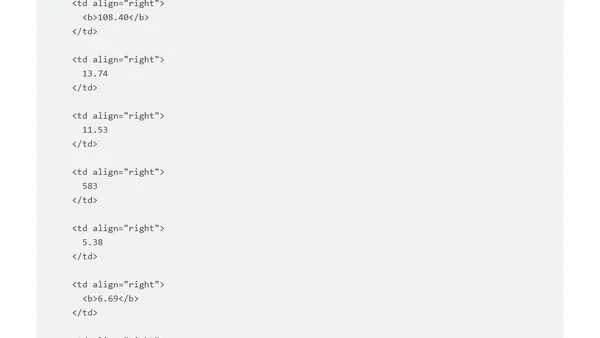
Analyzes the write overhead of ext4 journaling on SSDs, comparing performance with and without a journal and using noatime.
A technical deep dive into improving ext4 filesystem performance by optimizing the allocator to reduce e2fsck pass2 times.
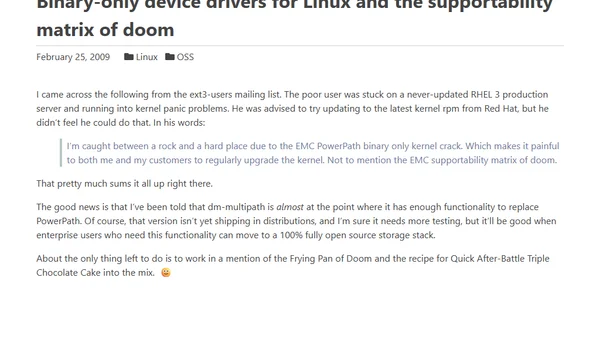
Discusses the challenges of binary-only Linux device drivers, using EMC PowerPath as an example, and the move towards open-source alternatives.
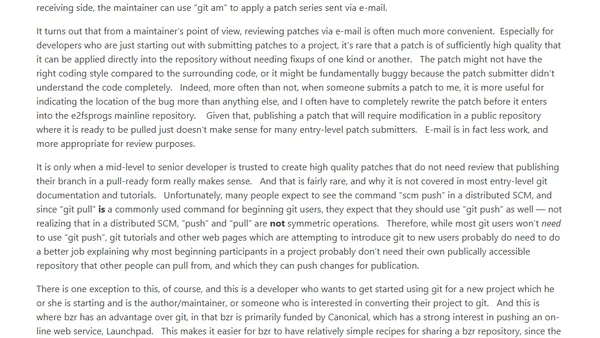
A response to a user's frustration with git's push command, explaining why direct pushes are rare and email patches are often preferred.
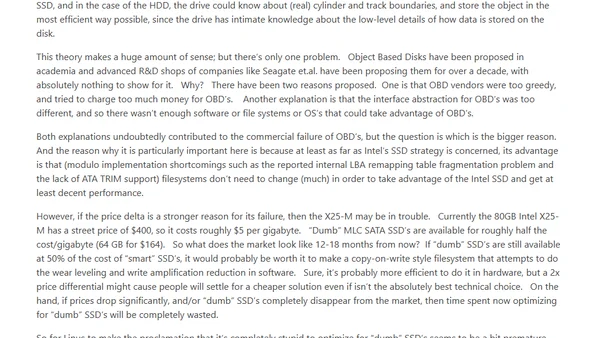
Explores whether operating systems and filesystems should be optimized for SSDs, discussing abstraction boundaries, wear leveling, and the TRIM command.
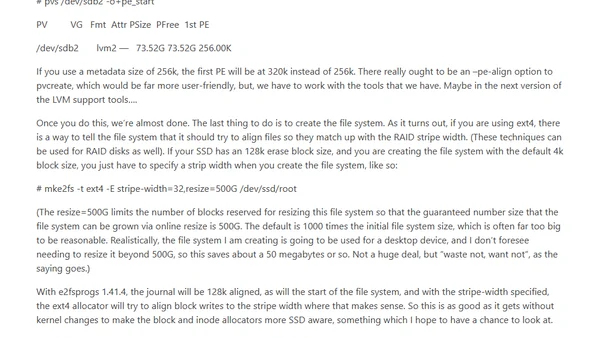
A technical guide on aligning Linux filesystem partitions to SSD erase block boundaries for optimal performance, covering fdisk settings and sector alignment.
A 2009 article questioning the activity and relevance of local Linux User Groups (LUGs) in the internet age, asking for reader experiences.
A request for open-source backup solutions that use a database for tracking incremental backups, avoiding inefficient hard-link directory trees.
A reflection on the philosophical conflict between idealism and pragmatism within the Debian project and the broader Free Software movement.
Analyzes Sun Microsystems' business struggles and potential acquisition, focusing on risks to its patent portfolio and the broader Linux/OSS community.
A programmer debates the ethics of downloading out-of-print, pirated ebooks when legal digital versions are unavailable, weighing copyright law against practical and environmental concerns.