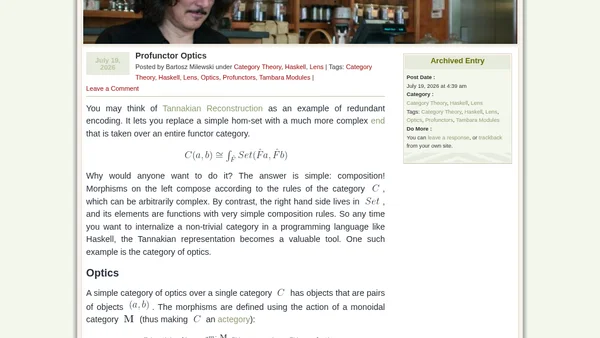
Profunctor Optics
Explores Profunctor Optics, Tannakian Reconstruction, and Tambara modules in category theory for functional programming.
Bartosz Milewski is a programmer and former theoretical physicist known for bridging category theory and practical software development. He writes about Haskell, C++, concurrency, and functional programming, and is the author of Category Theory for Programmers.
18 articles from this blog
Explores Profunctor Optics, Tannakian Reconstruction, and Tambara modules in category theory for functional programming.
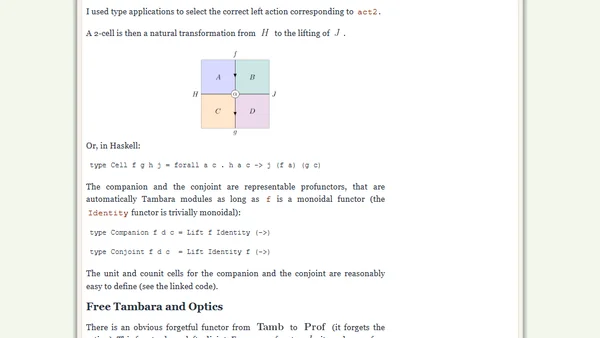
Explains Tannakian reconstruction using an analogy of photos to recover category structure via fiber functors.
Explores Tambara modules in category theory, their relation to Haskell optics, and monoidal functors with code examples.
Explores actegories in programming, starting from monoidal categories and their role in optics like lenses and prisms.
Explores Kan extensions in double categories, generalizing profunctor-based right and left Kan extensions with categorical and Haskell implementations.
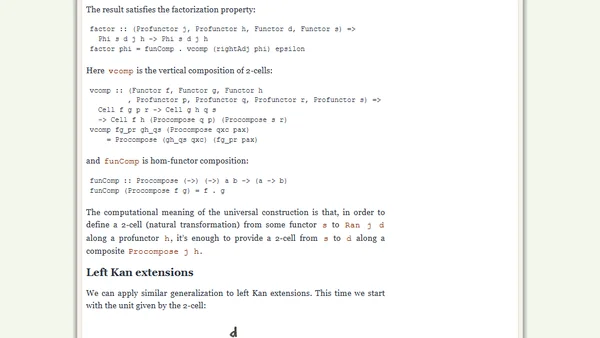
Explores Kan extensions in Haskell, defining right Kan extensions and their adjunctions with categorical foundations.
Explores tabulation in double categories as an analog of profunctor graphs, using universal properties and 2-cells.
Explores string diagrams in double categories, covering yanking identities, the spider lemma, and cartesian squares.
A Haskell tutorial implementing profunctor equipment with functors, profunctors, and 2-cells for category theory enthusiasts.
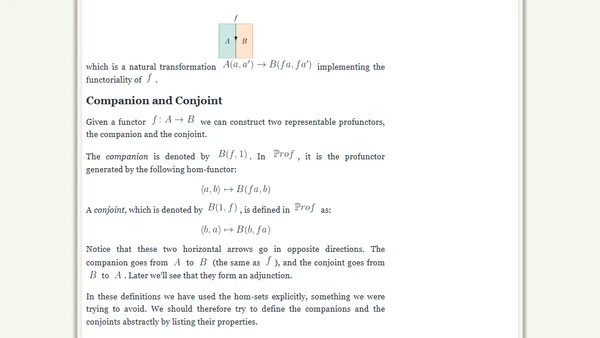
Explores profunctors in category theory, defining them as heteromorphisms between categories and their role in a double category combining functors and profunctors.
Explores the Axiom of Univalence in type theory, comparing type equality through isomorphisms and homotopy equivalences.
Explores advanced categorical modeling of identity types in homotopy type theory, focusing on fibrations, cofibrations, and path objects.
Explores identity and equality types in type theory, contrasting definitional vs. propositional equality and their role in proofs.
Explores categorical models for dependent type theory, connecting lambda calculus to fibrations and sections in locally cartesian closed categories.
Explores the concept of (weak) factorization systems in category theory, generalizing function decomposition into surjections and injections.
Explores the categorical definition of a subobject classifier, a key concept in topos theory, using set theory as a foundation.
A clear explanation of the attention mechanism in Large Language Models, focusing on how words derive meaning from context using vector embeddings.
A deep dive into composing comonads in Haskell, using Conway's Game of Life and Advent of Code puzzles to explore category theory and functional programming.