Fabric RTI 101: Hybrid Architectures
In practice, most real-time systems use a combination of streaming and batch processing rather than relying entirely on one or the other. This approac
I recently read the 2nd edition of a book on serverless ETL. Serverless ETL and Analytics with AWS Glue (2nd Edition) . I hadn’t had the chance to rea
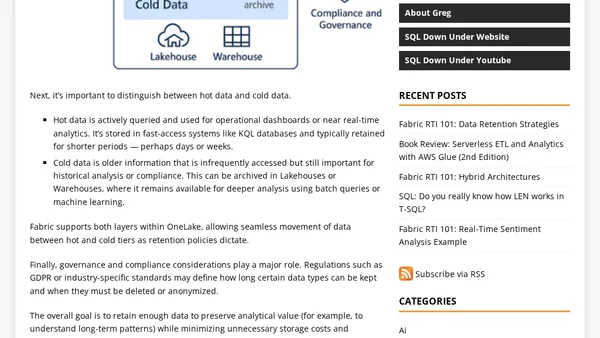
Learn about data retention strategies for streaming systems in Fabric RTI, covering hot/cold data tiers, governance, and cost optimization.
There’s a UK game show that I like to watch. It’s called Lingo and it’s the standard word game turned into a full TV show. It’s based on a US game sho
Learn how to scale Microsoft Fabric Eventstreams for real-time data pipelines, covering capacity, partitioning, monitoring, and resilience.
Was 2018 a leap year? What about the year 2000? Will 2100 be a leap year? When I was a young student at school, we learned that leap years were every
In Kusto Query Language (KQL), materialized views are a key optimization feature that improve the performance of repeated or computationally expensive
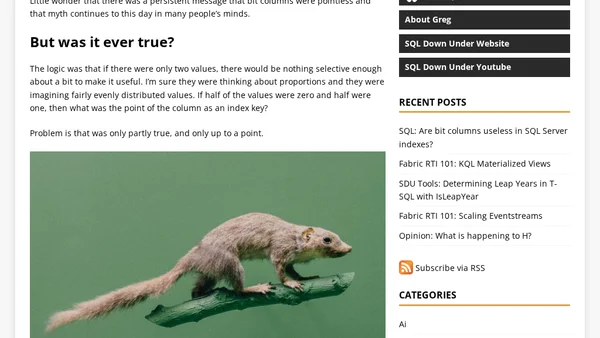
Debunking the myth that bit columns are useless in SQL Server indexes, emphasizing selectivity over value range.
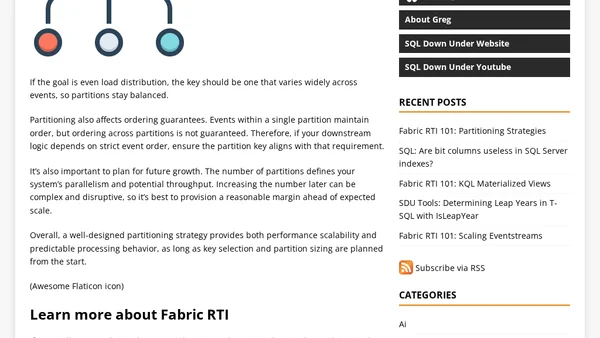
Learn partitioning strategies for Fabric RTI to improve scalability and performance in event-driven systems.
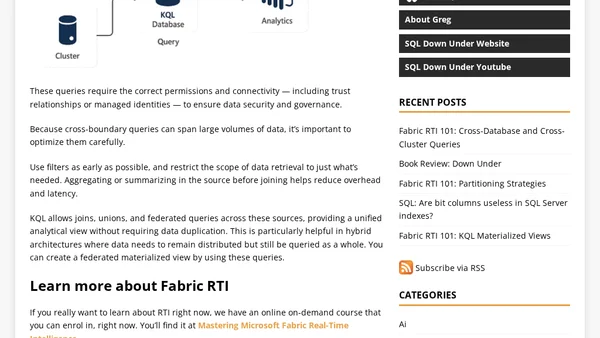
Learn how Fabric KQL enables cross-database and cross-cluster queries for unified analytics without data duplication.
Database column sizing: how to choose appropriate data types and lengths for numbers, dates, and strings in SQL.
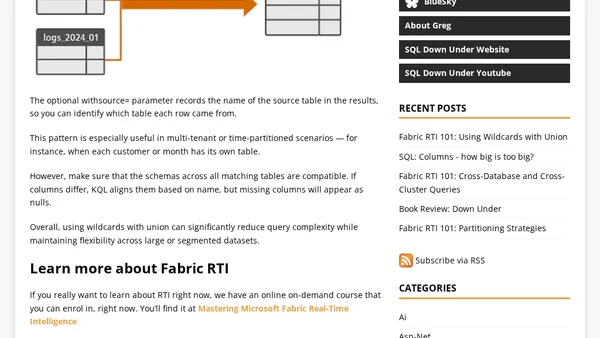
In KQL, the union operator can combine results from multiple tables, even when those tables follow a naming pattern. This is particularly useful in en
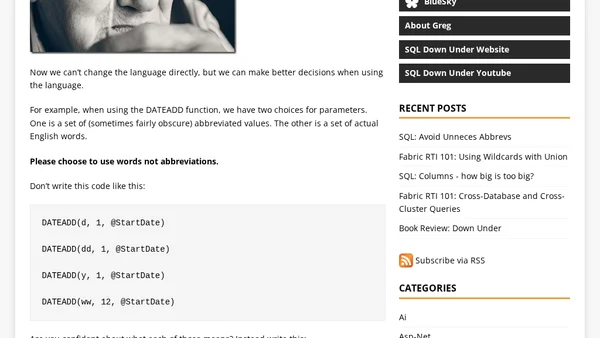
Many database developers (and other developers) seem to regard the endless use of abbreviations as some badge of honor. Don’t be one of these people.
KQL offers a wide range of specialized functions designed to handle advanced analytical tasks — particularly useful in real-time and large-scale telem
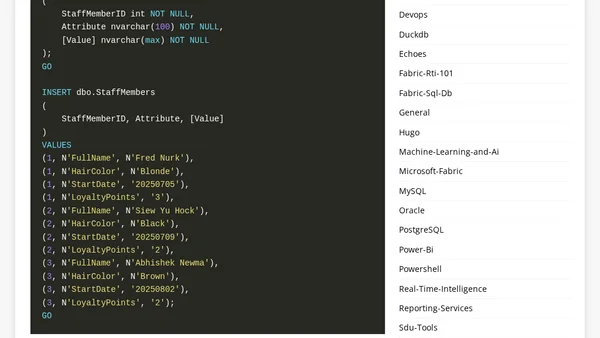
If you’ve been working with databases for any length of time, you will have come across implementations of Entity-Attribute-Value (EAV) tables (or non
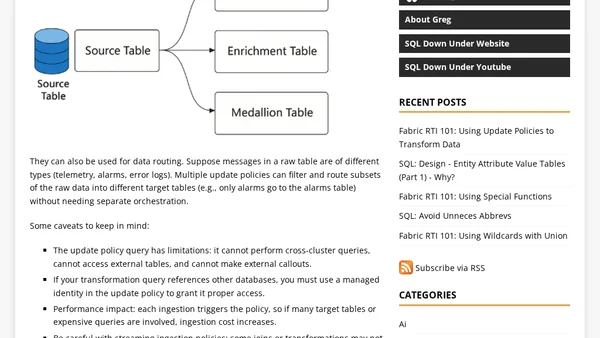
Update policies in KQL (and thus in Fabric) are a mechanism to automatically transform ingested data as it arrives. Rather than separately ingesting r