Fabric RTI 101: Handling Backpressure
Learn how to handle backpressure in real-time data systems with strategies like buffering, scaling, and prioritization.
Greg Low is a long-time Microsoft Data Platform MVP and Regional Director, sharing expert insights on SQL Server, Azure SQL, Microsoft Fabric, and real-time data architecture through practical articles and interviews.
54 articles from this blog
Learn how to handle backpressure in real-time data systems with strategies like buffering, scaling, and prioritization.
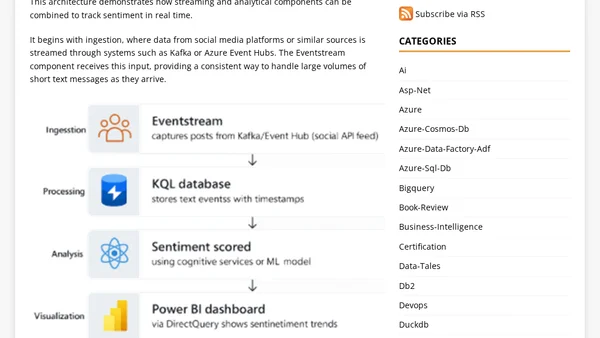
Monitoring brand reputation has become a continuous challenge in the age of social media. Platforms like X, Facebook, and Reddit can amplify sentiment
Learn partitioning strategies for Fabric RTI to improve scalability and performance in event-driven systems.
Explore cost considerations for streaming vs batch in Microsoft Fabric RTI, including compute, retention, and hybrid pipeline strategies.
Troubleshooting SQL Server error 'Failed to update the database because the database is read-only', caused by availability group failover and connection to wrong server.
I’ve never liked how the LEN function works in T-SQL for SQL Server. To test out what others thought, I recently posted a short quiz on my social netw
An analysis of flat adverbs (e.g., 'drive safe') and the debate over the 'ly' suffix in modern English usage.
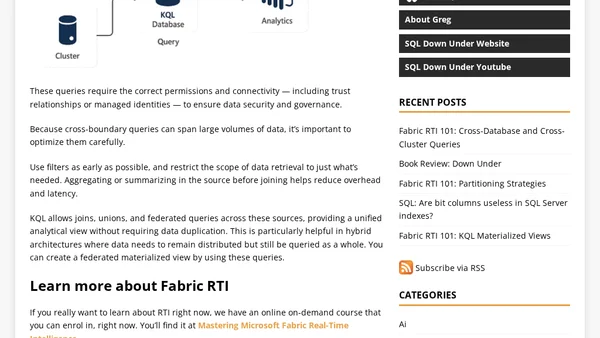
Learn how Fabric KQL enables cross-database and cross-cluster queries for unified analytics without data duplication.
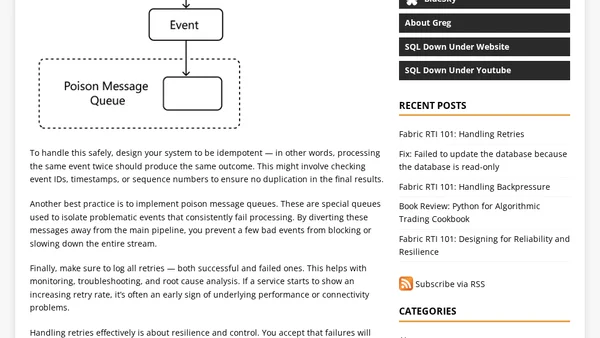
Learn best practices for handling retries in real-time streaming systems, including exponential backoff, idempotency, poison queues, and logging.
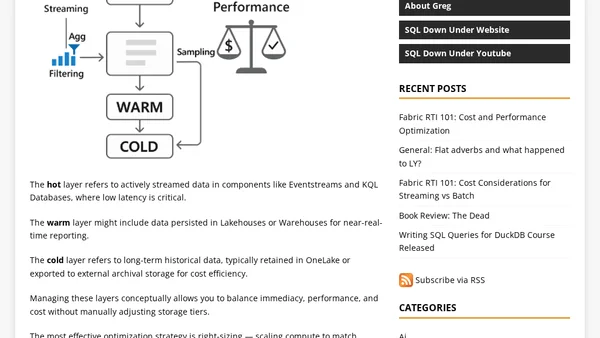
Learn how to optimize cost and performance in Microsoft Fabric RTI by selective streaming, pre-aggregation, sampling, and logical data tiering.
In practice, most real-time systems use a combination of streaming and batch processing rather than relying entirely on one or the other. This approac
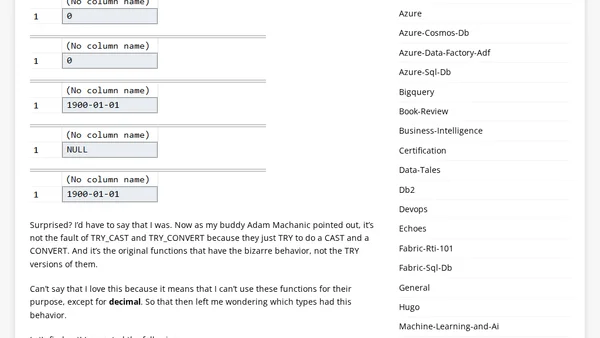
Explores surprising SQL Server behavior where TRY_CAST and TRY_CONVERT return non-NULL values for empty strings when casting to certain types, with a type-by-type analysis.
Database column sizing: how to choose appropriate data types and lengths for numbers, dates, and strings in SQL.
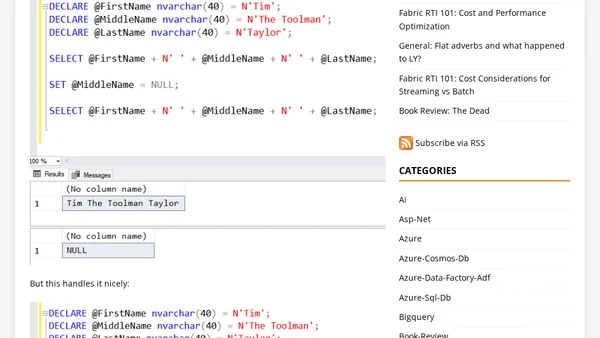
Explore SQL Server's CONCAT and CONCAT_WS functions for concatenating column values with delimiters, handling NULLs, and simplifying string aggregation.
I recently read the 2nd edition of a book on serverless ETL. Serverless ETL and Analytics with AWS Glue (2nd Edition) . I hadn’t had the chance to rea
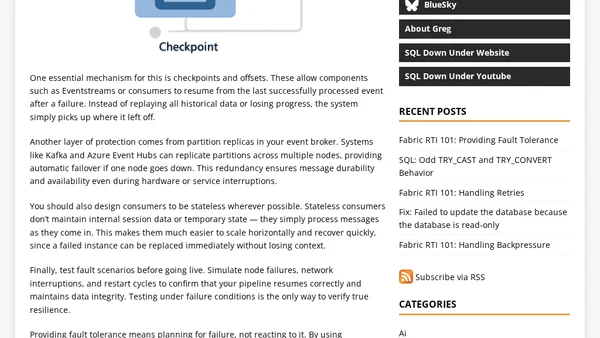
Learn how to design fault-tolerant real-time data pipelines using checkpoints, partition replicas, stateless consumers, and failure testing.
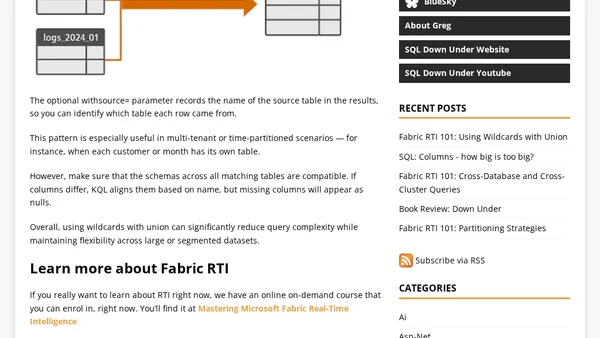
In KQL, the union operator can combine results from multiple tables, even when those tables follow a naming pattern. This is particularly useful in en
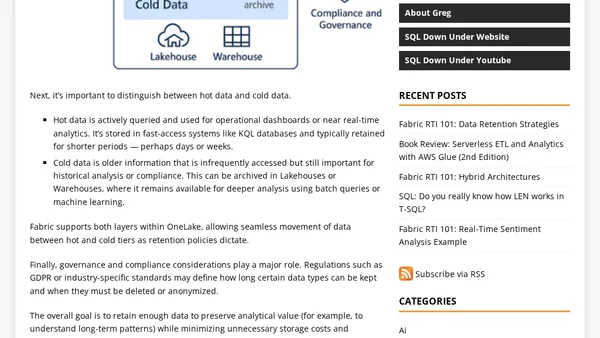
Learn about data retention strategies for streaming systems in Fabric RTI, covering hot/cold data tiers, governance, and cost optimization.
An expert's guide to scaling SQL Server performance, focusing on reducing database calls and improving application design.
A detailed review of 'Causal Inference with Bayesian Networks', covering its content, practical examples, and suitability for data scientists.