Fabric RTI 101: Designing for Reliability and Resilience
Learn key design principles for building reliable and resilient real-time streaming systems, including redundancy, failover, durability, and monitoring.
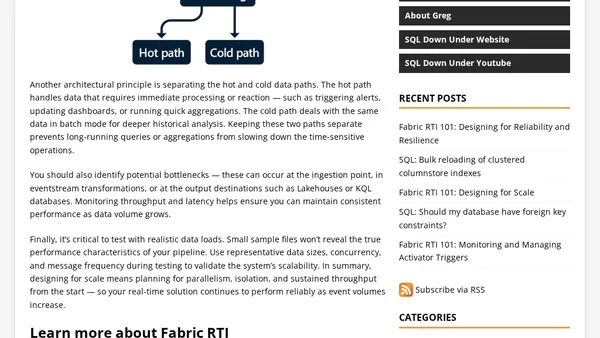
Learn key strategies for designing scalable real-time architectures, including partitioning, hot/cold path separation, bottleneck identification, and realistic load testing.
Learn to monitor and manage Activator triggers in Fabric RTI, including viewing trigger events, editing rules, and avoiding loops.
Learn how to handle backpressure in real-time data systems with strategies like buffering, scaling, and prioritization.
Learn best practices for handling retries in real-time streaming systems, including exponential backoff, idempotency, poison queues, and logging.
Explains replay and reprocessing in Microsoft Fabric RTI, covering event persistence, Delta Lake time travel, and use cases like debugging and audits.
Explore cost considerations for streaming vs batch in Microsoft Fabric RTI, including compute, retention, and hybrid pipeline strategies.
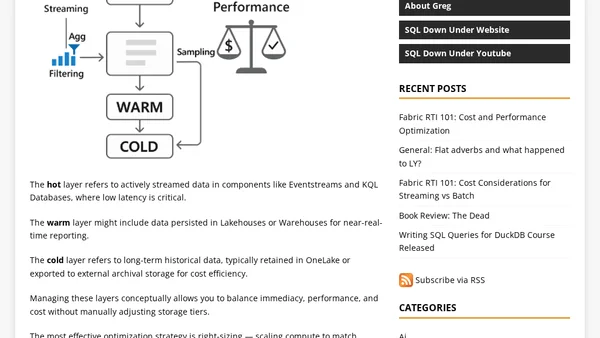
Learn how to optimize cost and performance in Microsoft Fabric RTI by selective streaming, pre-aggregation, sampling, and logical data tiering.
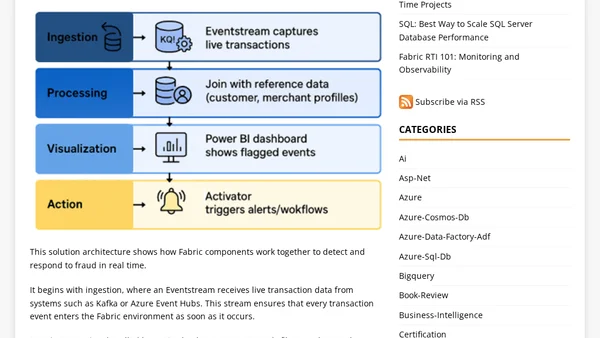
Real-time fraud detection using Fabric RTI: streaming pipelines, KQL anomaly detection, Power BI dashboards, and automated actions.
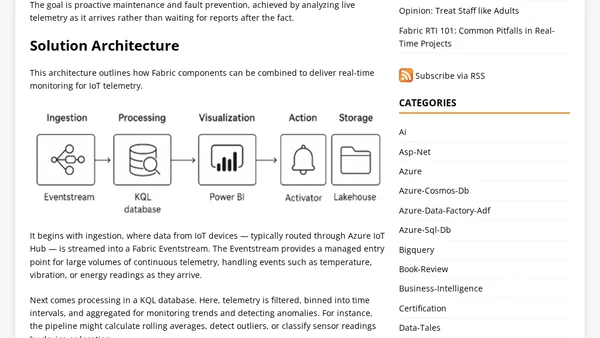
Learn to build a real-time IoT telemetry dashboard using Microsoft Fabric, Eventstream, KQL, Power BI, and Activator for proactive maintenance.
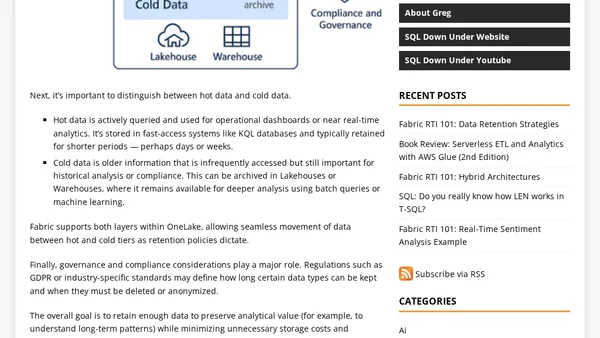
Learn about data retention strategies for streaming systems in Fabric RTI, covering hot/cold data tiers, governance, and cost optimization.
Learn how to scale Microsoft Fabric Eventstreams for real-time data pipelines, covering capacity, partitioning, monitoring, and resilience.
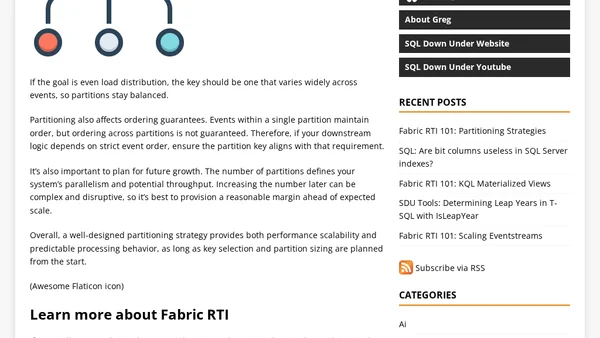
Learn partitioning strategies for Fabric RTI to improve scalability and performance in event-driven systems.