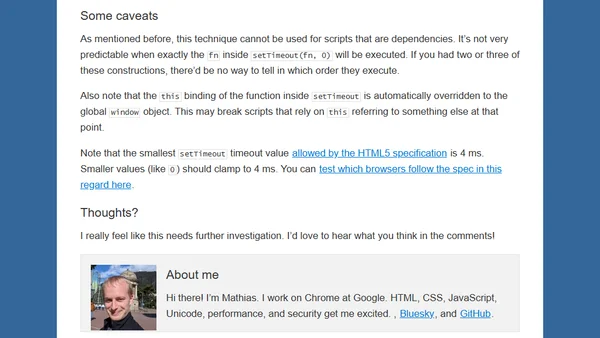
Why do browsers throttle JavaScript timers?
Explains why browsers throttle JavaScript timers like setTimeout to 4ms, and explores modern alternatives like scheduler.postTask for better performance.
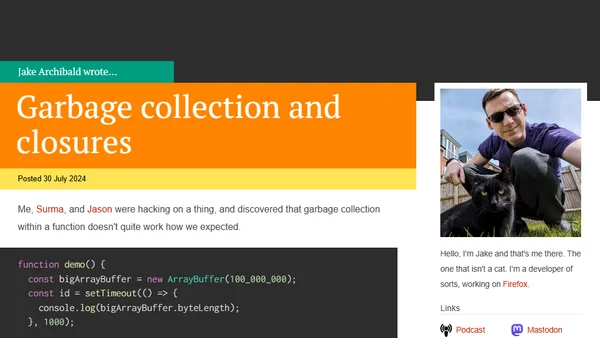
Explains a surprising JavaScript memory leak involving closures and garbage collection, with code examples.
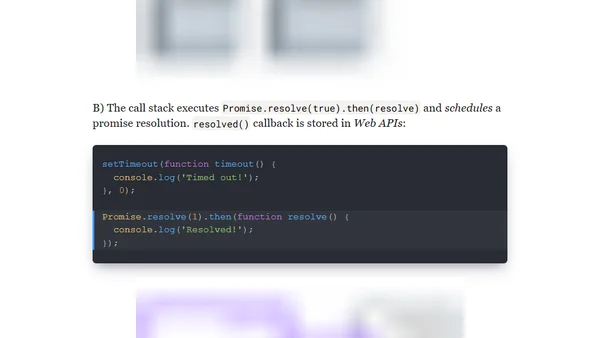
Explains why immediately resolved Promise callbacks execute before setTimeout(callback, 0) due to JavaScript's microtask (job) queue vs. macrotask queue.
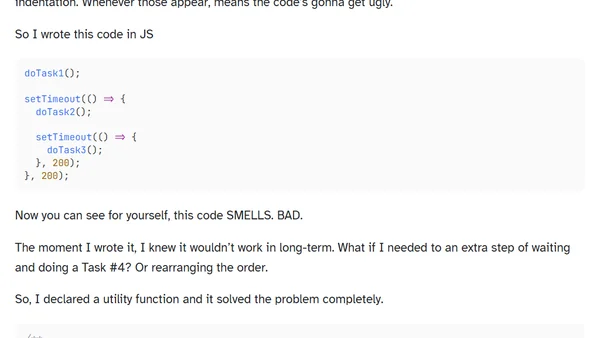
A guide to simplifying asynchronous JavaScript code by creating a promisified version of setTimeout for cleaner, more readable sequences.
Explains how JavaScript's setTimeout function can be used to sort an array by leveraging the event loop and delay timers.
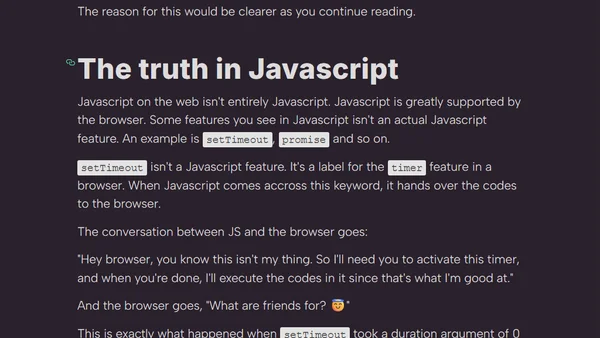
Explains how JavaScript's callback queue and event loop enable asynchronous execution, using setTimeout as a key example.
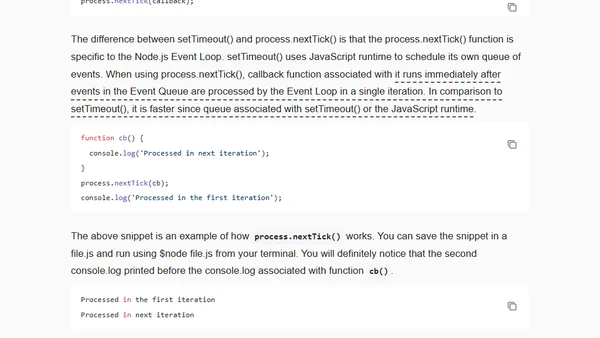
Explains the Node.js process.nextTick() method, how it defers execution to the next event loop iteration, and compares it to setTimeout().
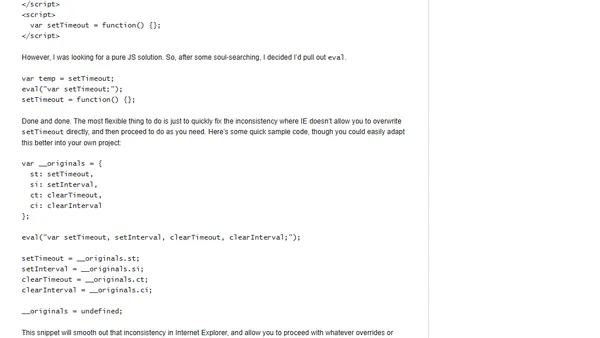
A technical guide to safely overriding global `setTimeout` and `setInterval` in JavaScript, covering browser compatibility and pitfalls.
Explains how using setTimeout with a 0ms delay can speed up window.onload by preventing JavaScript from blocking the event.
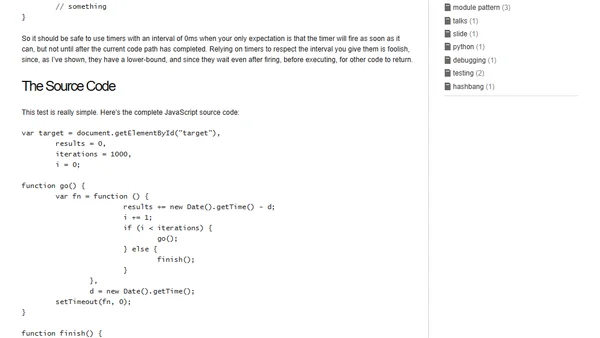
Explores the minimum delay for JavaScript timers like setTimeout, revealing browser-specific limits and implications for accurate timing.