SDU Tools: Determining Leap Years in T-SQL with IsLeapYear
Was 2018 a leap year? What about the year 2000? Will 2100 be a leap year? When I was a young student at school, we learned that leap years were every
In Kusto Query Language (KQL), materialized views are a key optimization feature that improve the performance of repeated or computationally expensive
Debunking the myth that bit columns are useless in SQL Server indexes, emphasizing selectivity over value range.
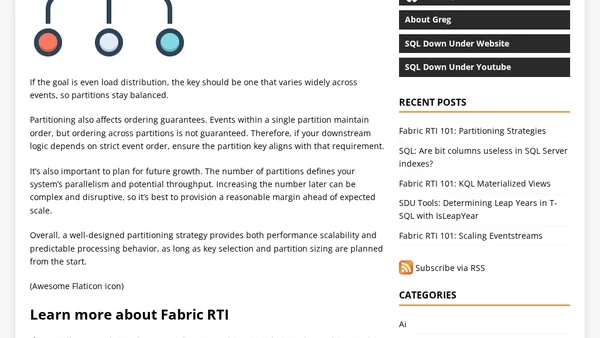
Learn partitioning strategies for Fabric RTI to improve scalability and performance in event-driven systems.
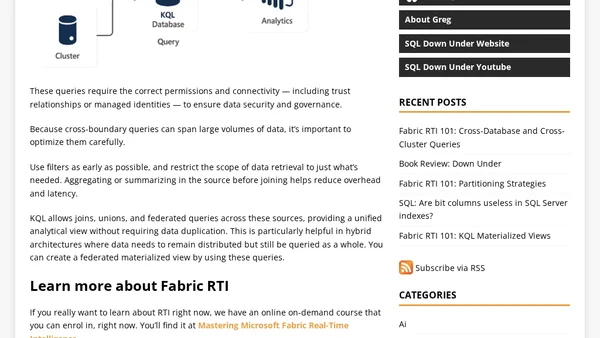
Learn how Fabric KQL enables cross-database and cross-cluster queries for unified analytics without data duplication.
Database column sizing: how to choose appropriate data types and lengths for numbers, dates, and strings in SQL.
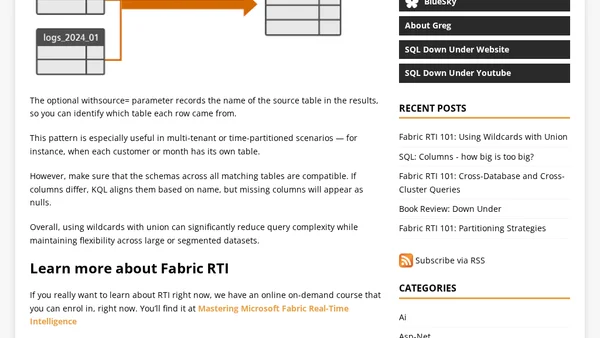
In KQL, the union operator can combine results from multiple tables, even when those tables follow a naming pattern. This is particularly useful in en
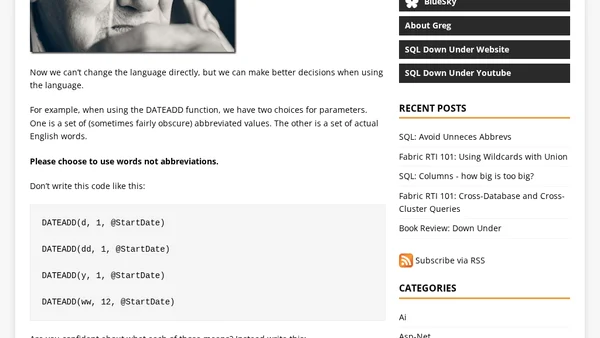
Many database developers (and other developers) seem to regard the endless use of abbreviations as some badge of honor. Don’t be one of these people.
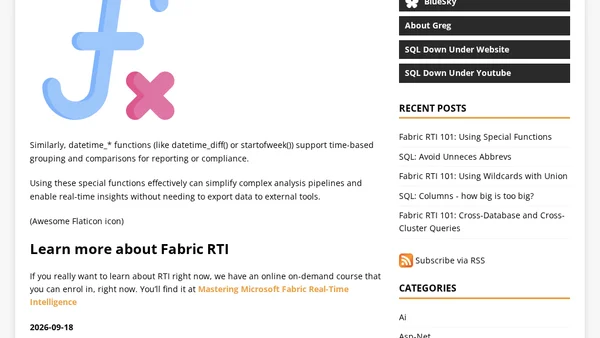
KQL offers a wide range of specialized functions designed to handle advanced analytical tasks — particularly useful in real-time and large-scale telem
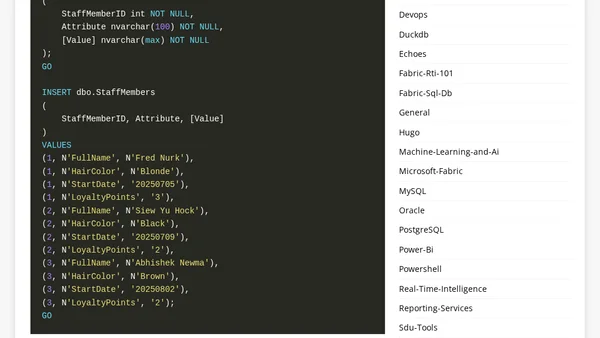
If you’ve been working with databases for any length of time, you will have come across implementations of Entity-Attribute-Value (EAV) tables (or non
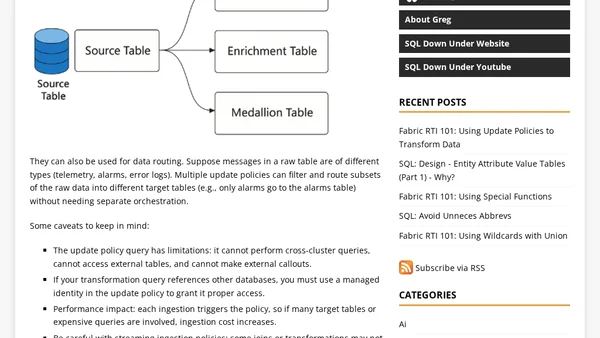
Update policies in KQL (and thus in Fabric) are a mechanism to automatically transform ingested data as it arrives. Rather than separately ingesting r