SQL: Avoid Unneces Abbrevs
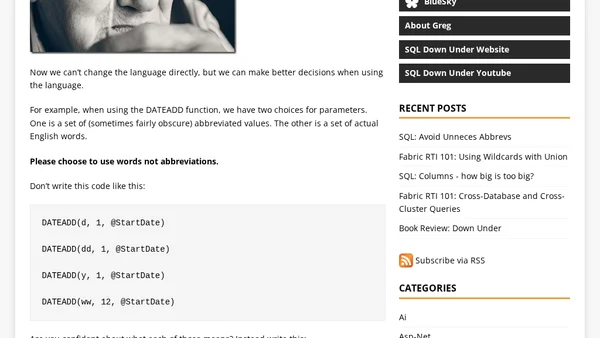
Many database developers (and other developers) seem to regard the endless use of abbreviations as some badge of honor. Don’t be one of these people.
Greg Low is a long-time Microsoft Data Platform MVP and Regional Director, sharing expert insights on SQL Server, Azure SQL, Microsoft Fabric, and real-time data architecture through practical articles and interviews.
54 articles from this blog
Many database developers (and other developers) seem to regard the endless use of abbreviations as some badge of honor. Don’t be one of these people.
There’s a UK game show that I like to watch. It’s called Lingo and it’s the standard word game turned into a full TV show. It’s based on a US game sho
Explains replay and reprocessing in Microsoft Fabric RTI, covering event persistence, Delta Lake time travel, and use cases like debugging and audits.
Many real-time data projects fail not because of the technology, but because of design assumptions and unnecessary complexity. One of the most common
KQL offers a wide range of specialized functions designed to handle advanced analytical tasks — particularly useful in real-time and large-scale telem
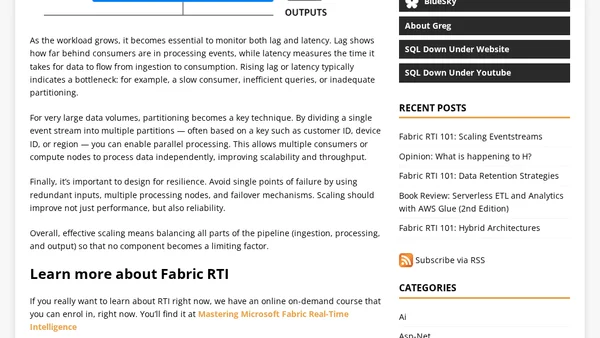
Learn how to scale Microsoft Fabric Eventstreams for real-time data pipelines, covering capacity, partitioning, monitoring, and resilience.
An opinion piece on why IT teams should avoid hiring clones of themselves, emphasizing the value of diverse backgrounds and perspectives in tech and development.
Opinion piece criticizing overly restrictive IT censorship that blocks developers from doing their jobs, urging companies to treat staff as adults.
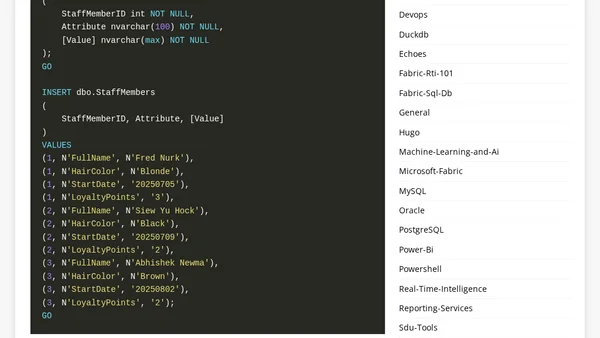
If you’ve been working with databases for any length of time, you will have come across implementations of Entity-Attribute-Value (EAV) tables (or non
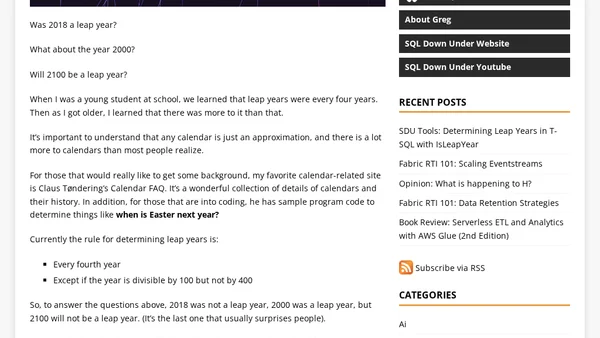
Was 2018 a leap year? What about the year 2000? Will 2100 be a leap year? When I was a young student at school, we learned that leap years were every
Security and governance are just as important in real-time streaming systems as they are in traditional batch pipelines — and in some cases, even more
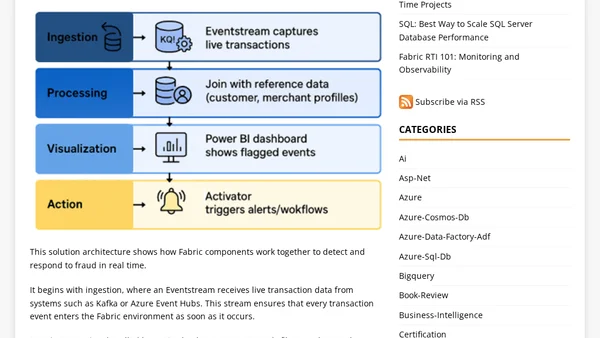
Real-time fraud detection using Fabric RTI: streaming pipelines, KQL anomaly detection, Power BI dashboards, and automated actions.
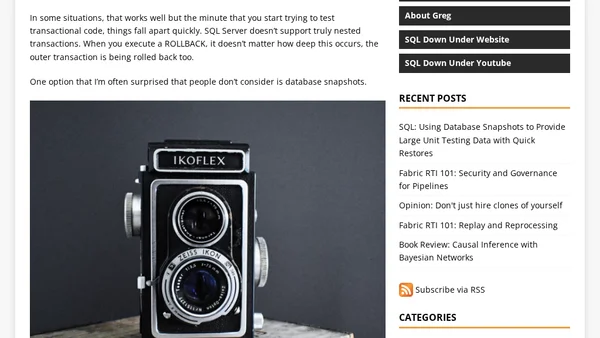
Using SQL Server database snapshots to provide large unit testing data with quick restores, avoiding transaction rollback limitations.
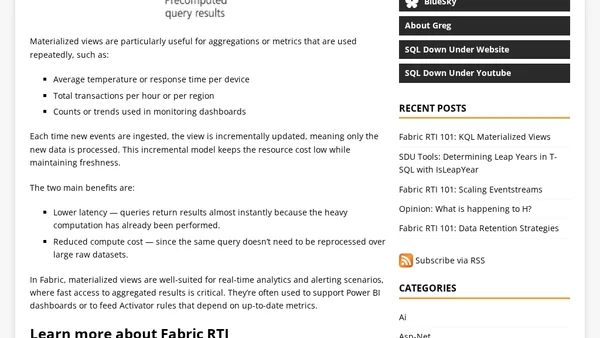
In Kusto Query Language (KQL), materialized views are a key optimization feature that improve the performance of repeated or computationally expensive
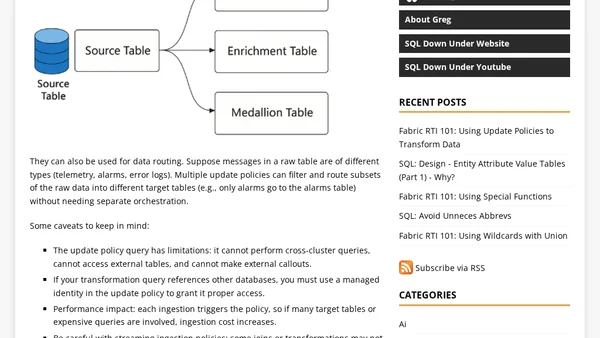
Update policies in KQL (and thus in Fabric) are a mechanism to automatically transform ingested data as it arrives. Rather than separately ingesting r
Learn key design principles for building reliable and resilient real-time streaming systems, including redundancy, failover, durability, and monitoring.
Compares two methods for bulk reloading SQL Server clustered columnstore indexes, recommending drop/recreate for best performance and packing.
Learn key strategies for designing scalable real-time architectures, including partitioning, hot/cold path separation, bottleneck identification, and realistic load testing.
Discussion on whether databases should use foreign key constraints, addressing common developer objections and advocating for their use.
Learn to monitor and manage Activator triggers in Fabric RTI, including viewing trigger events, editing rules, and avoiding loops.